


Page 138 - EER-2-3
P. 138
Explora: Environment
            and Resource                                  Climate change adaptation through indigenous practices in Ebonyi State


            relatively low, farmers in Nigeria have long implemented   may not always align with empirical meteorological data.
            indigenous climate adaptation practices, even before the   Nonetheless, local knowledge and metrological data can
            concept became a widely discussed topic in agricultural   complement each other in developing effective climate
            development. Although farmers may not fully understand   change resilience strategies.
            all the effects of climate change on their farms, they
            leverage  their  awareness  to  apply indigenous practices,   3.3. Extent of indigenous practice application
            thereby contributing to agricultural development.  Table 2 presents the extent to which farmers utilize indigenous
                                                               practices as climate change adaptation strategies. The results
                                                                                                       −
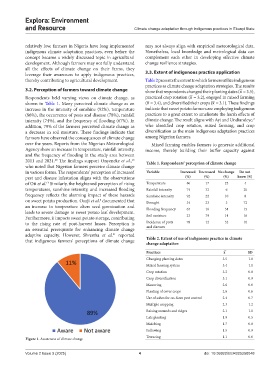
            3.2. Perception of farmers toward climate change   show that respondents changed their planting dates (x = 3.5),
                                                                                  −
            Respondents held varying views on climate change, as   practiced crop rotation (x = 3.2), engaged in mixed farming
                                                                −
                                                                                           −
            shown in Table 1. Many perceived climate change as an   (x = 3.4), and diversified their crops (x = 3.1). These findings
            increase in the intensity of sunshine (92%), temperature   indicate that sweet potato farmers are employing indigenous
            (86%), the occurrence of pests and disease (78%), rainfall   practices to a great extent to ameliorate the harsh effects of
                                                                                                             3
            intensity (74%), and the frequency of flooding (67%). In   climate change. The result aligns with Ayi and Undiandeye,
            addition, 79% of the farmers perceived climate change as   who identified crop rotation, mixed farming, and crop
            a decrease in soil moisture. These findings indicate that   diversification as the main indigenous adaptation practices
            farmers have observed the consequences of climate change   among Nigerian farmers.
            over the years. Reports from the Nigerian Meteorological   Mixed farming enables farmers to generate additional
            Agency show an increase in temperature, rainfall intensity,   income, thereby building their buffer capacity against
            and the frequency of flooding in the study area between
            2011 and 2021.  The findings support Onyeneke et al.,    Table 1. Respondents’ perception of climate change
                                                         15
                        20
            who noted that Nigerian farmers perceive climate change
            in various forms. The respondents’ perception of increased   Variable  Increased  Decreased  No change   Do not
            pest and disease infestation aligns with the observations           (%)     (%)     (%)   know (%)
                     14
            of Oti et al.  Similarly, the heightened perception of rising   Temperature  86  17  25      4
            temperatures,  sunshine  intensity,  and  increased  flooding   Rainfall intensity  74  32  6  20
            frequency reflects the alarming impact of these hazards   Sunshine intensity   92  22  10    8
            on sweet potato production. Osuji et al.  documented that   Drought   34    23       3       72
                                           8
            an increase in temperature alters seed germination and   Flooding frequency   67  16  34     15
            leads to severe damage to sweet potato leaf development.
            Furthermore, it impacts sweet potato storage, contributing   Soil moisture   23  79  14      16
            to the rising rate of post-harvest losses. Perception is   Incidence of pests   78  12  32   10
            an essential prerequisite for enhancing climate change   and diseases
            adaptive capacity. However,  Shrestha  et al.  reported
                                                 21
            that indigenous farmers’ perceptions of climate change   Table 2. Extent of use of indigenous practice in climate
                                                               change adaptation
                                                               Practices                        x̅        SD
                                                               Changing planting dates          3.5        1.0
                                                               Mixed farming system             3.4        1.1
                                                               Crop rotation                    3.2        0.8
                                                               Crop diversification             3.1        0.9
                                                               Manuring                         2.6        0.6
                                                               Planting of cover crops          2.6        0.6
                                                               Use of ashes for on-farm pest control  2.4  0.7
                                                               Multiple cropping                2.3        1.2
                                                               Raising mounds and ridges        2.1        1.1
                                                               Late planting                    1.9        0.5
                                                               Mulching                         1.7        0.8
                                                               Fallowing                        1.5        0.9
                                                               Terracing                        1.1        0.6
            Figure 1. Awareness of climate change

            Volume 2 Issue 3 (2025)                         4                           doi: 10.36922/EER025250048

