


Page 139 - EER-2-3
P. 139
Explora: Environment
            and Resource                                  Climate change adaptation through indigenous practices in Ebonyi State


            crop failure. It also supports the protection of rangeland   that indigenous practices and knowledge systems remain
            and promotes its sustainable use for livestock production,   effective tools for climate change adaptation among sweet
            rather than continuous ploughing, which can lead to soil   potato farmers. In addition, these systems are easily
            compaction. 22                                     accessible to them.
              Crop diversification enhances agricultural production   3.5. Factors determining the extent of indigenous
            by increasing variety. Ihenacho  et al.  observed that   practice utilization by sweet potato farmers
                                             7
            diversification  improves  soil  productivity,  reduces  the
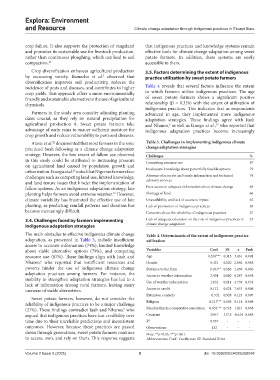
            incidence of pests and diseases, and contributes to higher   Table  4  reveals  that  several  factors  influence  the  extent
            crop yields. This approach offers a more environmentally   to which farmers utilize indigenous practices. The age
            friendly and sustainable alternative to the use of agricultural   of sweet potato farmers shows a significant positive
            chemicals.                                         relationship (β = 0.326) with the extent of utilization of
                                                               indigenous practices.  This indicates  that  as respondents
              Farmers in the study area consider adjusting planting   advanced in age, they implemented more indigenous
            dates crucial, as they rely on natural precipitation for   adaptation  strategies.  These  findings  agree with  Juah
            agricultural production 8. Sweet potato farmers take   and Nhamo,  as well as Izuogu et al.,  who reported that
                                                                                             23
                                                                         6
            advantage of early rains to ensure sufficient moisture for   indigenous adaptation practices become increasingly
            crop growth and reduce vulnerability to pests and diseases.
              Atasie et al.  documented that most farmers in the zone   Table 3. Challenges in implementing indigenous climate
                       22
            practiced bush fallowing as a climate change adaptation   change adaptation strategies
            strategy. However, the low extent of fallow use observed   Challenges                          %
            in this study could be attributed to increasing pressure   Competing resource use              87
            on agricultural land caused by population growth and
            urbanization. Izuogu et al.  noted that Nigerian farmers face   Inadequate knowledge about potentially feasible options  79
                                23
            challenges such as competing land use, limited knowledge,   Absence of accurate and timely information and technical   74
            and land tenure issues that hinder the implementation of   advisory services
            fallow systems. As an indigenous adaptation strategy, late   Poor access to adequate information about climate change  68
            planting helps farmers avoid extreme weather.  However,   Shortage of land                     66
                                                 13
            climate variability has frustrated the effective use of late   Unavailability and lack of access to inputs  62
            planting, as predicting rainfall patterns and duration has   Lack of promotion of indigenous practices  38
            become increasingly difficult.                     Concerns about the reliability of indigenous practices   27

            3.4. Challenges faced by farmers implementing      Lack of adequate education on the role of indigenous practices in   23
            indigenous adaptation strategies                   climate change adaptation
            The main obstacles to effective indigenous climate change   Table 4. Determinants of the extent of indigenous practice
            adaptation, as presented in  Table  3, include insufficient   utilization
            access to accurate information (74%), limited knowledge
            about viable alternative options (79%), and competing   Variables             Coef.  SE   z  Prob
            resource use (87%). These findings align with Juah and   Age                  0.326*** 0.315 3.461 0.001
            Nhamo,  who reported that insufficient resources and   Gender                 0.421  0.120 2.856 0.085
                  6
            poverty  hinder  the  use  of  indigenous  climate  change   Distance to the farm  −0.101** 0.166 1.459 0.060
            adaptation practices among farmers. For instance, the   Access to weather information  2.454  0.660 0.287 0.658
            inability to strengthen adaptation strategies has led to a   Use of weather information  1.032  0.111 4.739 0.031
            lack of information among rural  farmers, leaving many
            unaware of viable alternatives.                    Access to credit           0.112  0.121 7.633 0.006
                                                               Extension contacts         −0.532  0.928 0.125 0.907
              Sweet potato farmers, however, do not consider the
            reliability of indigenous practices to be a major challenge   Religion       −0.213*** 0.145 0.114 0.004
            (27%). These findings contradict Juah and Nhamo,  who   Membership in a cooperative association  −0.652 ** 0.725 1.813 0.058
                                                      6
            argued that indigenous practices have lost credibility over   Constant        254.7  317.5 -0.614 0.685
            time due to their unreliable predictions and inconsistent   R 2               0.567   -   -    -
            outcomes.  However,  because  these  practices  are passed   Observations      132    -   -    -
            down through generations, sweet potato farmers continue   Note: **p<0.05, ***p<0.01.
            to access, own, and rely on them. This response suggests   Abbreviations: Coef.: Coefficient; SE: Standard Error.


            Volume 2 Issue 3 (2025)                         5                           doi: 10.36922/EER025250048

