


Page 129 - EJMO-9-1
P. 129
Eurasian Journal of Medicine and
            Oncology
                                                                             Oncology care with AI chatbots and assistants


            Table 1. (Continued)
            Author/s         Invention/   Technology   Impact       Merits        Demerits     Future
                             Technology   used                                                 enhancement
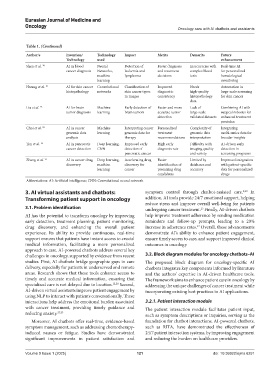
            Shen et al.  20  AI in blood   Neural     Detection of   Faster diagnosis   Inaccuracies with  Real-time AI
                             cancer diagnosis  Networks,   leukemia and   and treatment   complex blood   for personalized
                                          machine     lymphoma      decisions     tests        hematological
                                          learning                                             monitoring
            Hwang et al.  21  AI for skin cancer  Convolutional   Classification of   Improved   Needs   Automation in
                             histopathology  networks  skin cancer types   diagnostic   high-quality   large-scale screening
                                                      in images     consistency   histopathology   for skin cancer
                                                                                  data
            Liu et al.  22   AI for brain   Machine   Early detection of   Faster and more   Lack of   Combining AI with
                             tumor diagnosis  learning  brain tumors  accurate tumor   large-scale   surgical robotics for
                                                                    detection     validated datasets  enhanced treatment
                                                                                               precision
            Choi et al.  23  AI in cancer   Machine   Interpreting cancer  Personalized   Complexity of   Integrating
                             genomic data   learning  genomic data for   treatment   genomic data   multi-omics data for
                             analysis                 therapy       recommendations  interpretation  broader insights
            Tan et al.  24   AI in pancreatic   Deep learning,   Improved early   High early   Difficulty with   AI-driven early
                             cancer detection  CNN    detection of   diagnosis rate  imaging quality   detection in
                                                      pancreatic cancer           and variety  screening programs
            Zhang et al.  25  AI in cancer drug  Deep learning,   Accelerating drug   Faster   Limited by   Improved integration
                             discovery    machine     discovery for   identification of   databases and   with patient-specific
                                          learning    cancer        promising drug   accuracy  data for personalized
                                                                    candidates                 drugs
            Abbreviations: AI: Artificial intelligence; CNN: Convolutional neural network.

            3. AI virtual assistants and chatbots:             symptom  control through chatbot-assisted care.  In
                                                                                                        6,20
            Transforming patient support in oncology           addition, AI tools provide 24/7 emotional support, helping
                                                               reduce stress and improve overall well-being for patients
            3.1. Problem identification                        undergoing cancer treatment.  Finally, AI-driven chatbots
                                                                                      23
            AI has the potential to transform oncology by improving   help improve treatment adherence by sending medication
            early detection, treatment planning, patient monitoring,   reminders and follow-up prompts, leading to a 20%
            drug discovery, and enhancing the overall patient   increase in adherence rates.  Overall, these advancements
                                                                                     17
            experience. Its ability to provide continuous, real-time   demonstrate AI’s ability to enhance patient engagement,
            support ensures that patients have instant access to crucial   ensure timely access to care, and support improved clinical
            medical information, facilitating a more personalized   outcomes in oncology.
            approach to care. AI-powered chatbots address several key
            challenges in oncology, supported by evidence from recent   3.2. Block diagram modules for oncology chatbots–AI
            studies. First, AI chatbots bridge geographic gaps in care   The proposed block diagram for oncology-specific AI
            delivery, especially for patients in underserved and remote   chatbots integrates key components informed by literature
            areas. Research shows that these tools enhance access to   and the authors’ expertise in AI-driven healthcare tools.
            timely and accurate medical information, ensuring that   The framework aims to enhance patient care in oncology by
            specialized care is not delayed due to location. 12,20  Second,   addressing the unique challenges of cancer treatment while
            AI-driven virtual assistants improve patient engagement by   incorporating existing best practices in AI applications.
            using NLP to interact with patients conversationally. These
            interactions help address the emotional burden associated   3.2.1. Patient interaction module
            with cancer treatment, providing timely guidance and   The patient interaction module facilitates patient input,
            reducing anxiety. 23,25                            such as symptom descriptions or inquiries, serving as the
              Moreover, AI chatbots offer real-time, evidence-based   foundation for chatbot interactions. AI-powered chatbots,
            symptom management, such as addressing chemotherapy-  such as RITA, have demonstrated the effectiveness of
            induced nausea or fatigue. Studies have demonstrated   24/7 patient interaction systems, by improving engagement
            significant  improvements  in  patient  satisfaction  and   and reducing the burden on healthcare providers.


            Volume 9 Issue 1 (2025)                        121                              doi: 10.36922/ejmo.6251

