


Page 133 - EJMO-9-1
P. 133
Eurasian Journal of Medicine and
            Oncology
                                                                             Oncology care with AI chatbots and assistants


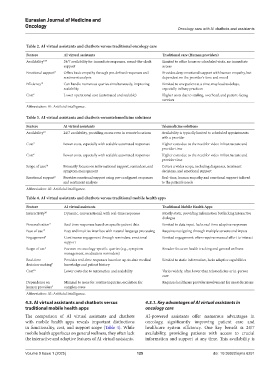
            Table 2. AI virtual assistants and chatbots versus traditional oncology care
            Feature         AI virtual assistants                     Traditional care (Human providers)
            Availability 9,17  24/7 availability for immediate responses, round-the-clock   Limited to office hours or scheduled visits, no immediate
                            support                                   access
            Emotional support 5  Offers basic empathy through pre-defined responses and   Provides deep emotional support with human empathy, but
                            sentiment analysis                        dependent on the provider’s time and mood
            Efficiency 10   Can handle numerous queries simultaneously, improving   Limited to one patient at a time, may lead to delays,
                            scalability                               especially in busy practices
            Cost 9          Lower operational cost (automated and scalable)  Higher costs due to staffing, overhead, and patient-facing
                                                                      services
            Abbreviation: AI: Artificial intelligence.
            Table 3. AI virtual assistants and chatbots versustelemedicine solutions

            Feature         AI virtual assistants                     Telemedicine solutions
            Availability 10  24/7 availability, providing access even in remote locations  Availability is typically limited to scheduled appointments
                                                                      with a provider
            Cost 9          Lower costs, especially with scalable automated responses  Higher costs due to the need for video infrastructure and
                                                                      provider time
            Cost 9          Lower costs, especially with scalable automated responses  Higher costs due to the need for video infrastructure and
                                                                      provider time
            Scope of care 10  Primarily focuses on informational support, reminders, and   Covers a wider scope, including diagnoses, treatment
                            symptom management                        decisions, and emotional support
            Emotional support 5  Provides emotional support using pre-configured responses   Real-time, human empathy and emotional support tailored
                            and sentiment analysis                    to the patient’s needs
            Abbreviation: AI: Artificial intelligence.
            Table 4. AI virtual assistants and chatbots versus traditional mobile health apps
            Feature         AI virtual assistants                     Traditional Mobile Health Apps
            Interactivity 10  Dynamic, conversational, with real-time responses  Mostly static, providing information but lacking interactive
                                                                      dialogue
            Personalization 9  Real-time responses based on specific patient data  Limited to data input, lacks real-time adaptive responses
            Ease of use 17  Easy and intuitive interface with natural language processing  Requires navigating through multiple screens and inputs
            Engagement 5    Continuous engagement through reminders, emotional   Limited engagement; often requires manual effort to interact
                            support
            Scope of use 6  Focuses on oncology-specific queries (e.g., symptom   Broader focus on health tracking and general wellness
                            management, medication reminders)
            Real-time       Provides real-time responses based on up-to-date medical   Limited to static information, lacks adaptive capabilities
            decision-making 9  knowledge and patient history
            Cost 10         Lower costs due to automation and scalability  Varies widely, often lower than telemedicine or in-person
                                                                      care
            Dependence on   Minimal to none for routine inquiries; escalation for   Requires healthcare provider involvement for most decisions
            human providers 5  complex cases
            Abbreviation: AI: Artificial intelligence.

            4.3. AI virtual assistants and chatbots versus     4.3.1. Key advantages of AI virtual assistants in
            traditional mobile health apps                     oncology care
            The comparison of AI virtual assistants and chatbots   AI-powered assistants offer numerous advantages in
            with mobile health apps reveals  important distinctions   oncology, significantly improving patient care and
            in functionality, cost, and support scope (Table 4). While   healthcare system efficiency. One key benefit is 24/7
            mobile health apps focus on general wellness, they often lack   availability, providing patients with access to crucial
            the interactive and adaptive features of AI virtual assistants.  information and support at any time. This availability is


            Volume 9 Issue 1 (2025)                        125                              doi: 10.36922/ejmo.6251

