


Page 247 - EJMO-9-1
P. 247
Eurasian Journal of Medicine and
            Oncology
                                                                        EGFR and PIK3CA mutations in lung cancer patients


            2.3. Statistical analysis                          Table 2. Demographic and clinical features of the recruited
                                                               cases
            Data entry and figure creation were performed using
            GraphPad  Prism  (v8.0;  GraphPad  Software).  Statistical   Variables  Number of patients  Percentages (%)
            analysis was conducted using Jamovi 2.6.17.0 (Austria) for   Gender
            Windows, with the χ² test applied. For a small sample size,   Male        46               77
            the Fisher exact test was used. A p<0.05 was considered
            statistically significant.                          Female                14               23
                                                               Age
            3. Results                                          <60 years             30               50
            3.1. Case selection                                 ≥60 years             30               50
                                                               Tobacco smoking
            A total of 90  fresh  resection  specimens  were  collected
            from four types of surgeries: rigid bronchoscopy, wedge   Yes             42               70
            resection, pneumonectomy, and lobectomy. Of these, 60   No                18               30
            were confirmed as LC cases, compromising 46 men and   Histological type
            14 women, yielding a male-to-female ratio of 3:1. The   AC a              34              56.7
            patients’ ages ranged from 31 to 83 years, with a median   SCC b          13              21.7
            age of 60 years and an average age of 59.25 years. Notably,   LCC c       1               1.7
            70% of the patients, all of whom were men, were current   NET d           6                10
            smokers. Clinicopathological features revealed that    e
            adenocarcinomas were the most common histological   PSC                   1               1.7
            type, representing 56.7% of cases, followed by squamous   Mixed histology  3              4.9
            cell carcinoma, which was reported in 21.7% of cases.   Unknown           2               3.3
            Regarding staging, the majority of patients were diagnosed   TNM staging
            at Stage III (31.7%), followed by Stage II (28.3%) and   I                16              26.7
            Stage I (26.7%), and only 10% were identified at stage IV   II            17              28.3
            (Table 2).
                                                                III                   19              31.7
            3.2. Identification of oncogenic and clinically     IV                    6                10
            actionable mutations                                Unknown               2               3.3
            Analysis of the mutational status showed that 53.3%   Notes:  Adenocarcinoma;  Squamous cell carcinoma;  Large cell
                                                                    a
                                                                                                 c
                                                                                b
                                                                                       e
                                                                       d
            of patients (32/60) did not have any targeted driver   carcinoma;  Neuroendocrine tumor;  Pulmonary sarcomatoid
            mutation in the three genes. The remaining 28  cases   carcinoma.
                                                               Abbreviation: TNM: Tumor-node-metastasis.
            (46.7%) harbored at least one single mutation in the
            targeted genes.
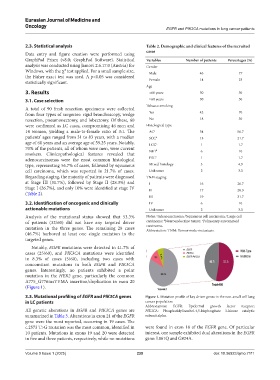
              Notably, EGFR mutations were detected in 41.7% of
            cases (25/60), and  PIK3CA mutations were identified
            in 8.3% of cases (5/60), including two cases with
            concomitant mutations in both  EGFR and  PIK3CA
            genes. Interestingly, no patients exhibited a point
            mutation in the  HER2 gene, particularly the common
            A775_G776insYVMA insertion/duplication in exon 20
            (Figure 1).
            3.3. Mutational profiling of EGFR and PIK3CA genes   Figure 1. Mutation profile of key driver genes in the non-small cell lung
            in LC patients                                     cancer population.
                                                               Abbreviations:   EGFR:  Epidermal  growth  factor  receptor;
            All genetic alterations in  EGFR and  PIK3CA genes are   PIK3CA:  Phosphatidylinositol-4,5-bisphosphate  3-kinase  catalytic
            summarized in Table 3. Alterations in exon 21 of the EGFR   subunit alpha.
            gene were the most reported, occurring in 19 cases. The
            c.2573 T>G mutation was the most common, identified in   were found in exon 18 of the EGFR gene. Of particular
            10 patients. Mutations in exons 19 and 20 were detected   interest, one sample exhibited dual alterations in the EGFR
            in five and three patients, respectively, while no mutations   gene: L861Q and G824A.


            Volume 9 Issue 1 (2025)                        239                              doi: 10.36922/ejmo.7111

