


Page 246 - EJMO-9-1
P. 246
Eurasian Journal of Medicine and
            Oncology
                                                                        EGFR and PIK3CA mutations in lung cancer patients


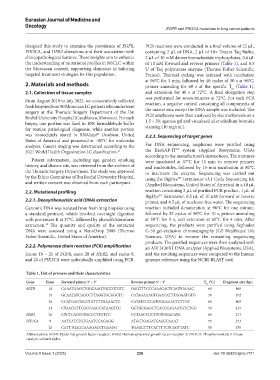
            designed this study to examine the prevalence of EGFR,   PCR reactions were conducted in a final volume of 22 μL,
            PIK3CA, and HER2 alterations and their association with   containing 2 μL of DNA, 2 μL of 10× Dream Taq Buffer,
            clinicopathological features. These insights aim to enhance   2 μL of 10 mM deoxyribonucleotide triphosphates, 0.6 μL
            the understanding of mutational profiles in NSCLC within   of 10 μM forward and reverse primers (Table 1), and 0.5
            the Moroccan context, supporting clinicians in tailoring   U of Taq polymerase enzyme (Thermo Fisher Scientific,
            targeted treatment strategies for this population.  France). Thermal cycling was initiated with incubation
                                                               at 96°C for 3 min, followed by 40 cycles of 30 s at 96°C,
            2. Materials and methods                           primer  annealing  for  60  s  at  the  specific  T   (Table  1),
                                                                                                   m
            2.1. Collection of tissue samples                  and extension for 40 s at 72°C. A  final elongation step
                                                               was performed for seven minutes at 72°C. For each PCR
            From August 2019 to July 2022, we consecutively collected
            fresh biopsies from 90 Moroccan LC patients who underwent   reaction, a negative control containing all components of
            surgery at the Thoracic Surgery Department of the Ibn   the master mix except the DNA sample was included. The
                                                               PCR amplicons were then analyzed by electrophoresis on a
            Rochd University Hospital (Casablanca, Morocco). For each   1.5 – 2% agarose gel and visualized after ethidium bromide
            biopsy, one portion was fixed in 10% formaldehyde buffer
            for  routine  pathological diagnosis,  while another portion   staining (10 mg/mL).
            was immediately stored in RNAlater  (Ambion, United   2.2.3. Sequencing of target genes
                                          ®
            States of America) and preserved at −80°C for molecular
            analyses. Cancer staging was determined according to the   For DNA sequencing, amplicons were purified using
            2021 World Health Organization LC classification. 21  the ExoSAP-IT™ system (Applied Biosystems, USA)
                                                               according to the manufacturer’s instructions. The mixtures
              Patient information, including age, gender, smoking   were incubated at 37°C for 15  min to remove primers
            history, and disease site, was retrieved from the archives of   and nucleotides, followed by 15-min incubation at 80°C
            the Thoracic Surgery Department. The study was approved   to inactivate the enzyme. Sequencing was carried out
            by the Ethics Committee of Ibn Rochd University Hospital,   using the BigDye™ Terminator v3.1 Cycle Sequencing Kit
            and written consent was obtained from each participant.  (Applied Biosystems, United States of America) in a 10 μL
            2.2. Mutational profiling                          reaction containing 2 μL of purified PCR product, 1 μL of
                                                               BigDye  Terminator, 0.5 μL of 10 μM forward or reverse
                                                                     ®
            2.2.1. Deoxyribonucleic acid (DNA) extraction      primer, and 6.5 μL of nuclease-free water. The sequencing
            Genomic DNA was isolated from fresh lung biopsies using   reaction  included  denaturation  at  96°C  for  one  minute,
            a  standard protocol, which involved overnight  digestion   followed by 25 cycles of 96°C for 10 s, primer annealing
            with proteinase K at 37°C, followed by phenol/chloroform   at 50°C for 5 s, and extension at 60°C for 4  min. After
            extraction.   The quantity and quality of  the  extracted   sequencing, the products were purified using Sephadex
                    22
            DNA were assessed using a NanoDrop 2000 (Thermo    G-50 gel-exclusion chromatography (GE Healthcare Life
            Fisher Scientific, United States of America).      Sciences, USA) to remove the remaining sequencing
                                                               products. The purified sequences were then analyzed with
            2.2.2. Polymerase chain reaction (PCR) amplification  an ABI 3130XL DNA analyzer (Applied Biosystems, USA),
            Exons 18 – 21 of EGFR, exon 20 of HER2, and exons 9,   and the resulting sequences were compared to the human
            and 20 of PIK3CA were individually amplified using PCR.   genome reference using the NCBI-BLAST tool.


            Table 1. List of primers and their characteristics
            Gene     Exon  Forward primer 5’ – 3’        Reverse primer 5’ – 3’         T  (°C)  Fragment size (bp)
                                                                                         m
            EGFR      18   CAAATGAGCTGGCAAGTGCCGTGTC     GAGTTTCCCAAACACTCAGTGAAAC        60         400
                      19   GCAATATCAGCCTTAGGTGCGGCTC     CATAGAAAGTGAACATTTAGGATGTG       58         372
                      20   CCATGAGTACGTATTTTGAAACTC      CATATCCCCATGGCAAACTCTTGC         60         408
                      21   CTAACGTTCGCCAGCCATAAGTCC      GCTGCGAGCTCACCCAGAATGTCTGG       58         415
            HER2      20   CTCTCAGCGTACCCTTGTCC          CCTAGCCCCTTGTGGACATA             60         273
            PIK3CA    9    AATCATCTGTGAATCCAGAGG         ATGCTGAGATCAGCCAAAT              55         273
                      20   CATTTGAGCAAAGACCTGAAGG        TGAGCTTTCATTTTCTCAGTTATC         58         370
            Abbreviations: EGFR: Epidermal growth factor receptor; HER2: Human epidermal growth factor receptor 2; PIK3CA: Phosphoinositide 3-kinase
            catalytic subunit alpha.


            Volume 9 Issue 1 (2025)                        238                              doi: 10.36922/ejmo.7111

