


Page 157 - EJMO-9-3
P. 157
Eurasian Journal of
            Medicine and Oncology                                              Pfannenstiel incision in endometrial cancer


            hysterectomy. After the removal of the uterus through the   Table 1. Comparison of demographic and
            vagina, a powder-free surgical glove was inserted into the   clinicopathological characteristics of study
            abdominal cavity. The glove was filled with the retrieved   participants (n=130)
            lymph nodes,  the open  end was clipped, and the glove   Characteristics  Group 1 (Pfannenstiel   Group 2   p
            was extracted through the vagina. The procedure was                incision)     (laparoscopy)
            completed following hemostasis.                    Number of          63             67        -
                                                               patients (n)
            2.3. Statistical analysis
                                                               Mean age (years)  60.65±9.5    60.75±9.2  0.96
            Statistical analyses were performed using the Statistical   Mean BMI   33.1±5.5    34.2±4.7  0.225
            Package for the Social Sciences statistics (Version 22.0.,   (kg/m )
                                                                   2
            IBM, USA) for Windows. For continuous variables, mean,   Surgical stage (n)
            median, and  standard deviation  were calculated. The   IA            54             49      0.078
            Student’s  t-test, Mann–Whitney U-test, and Kruskal–
            Wallis tests were used for comparisons between continuous   IB        9              18
            variables, whereas the Fisher’s exact test was conducted   Grade (n)
            for categorical variables. Kaplan–Meier curves were   1               40             47      0.702
            constructed to assess overall survival (OS) and disease-free   2      23             20
            survival (DFS) in both groups. Statistical significance was   LVSI (n)
            defined as p<0.05.                                  Negative          55             62      0.322

            3. Results                                          Positive          8              5
                                                               Cytology (n)
            3.1. Patient demographics and baseline              Negative          61             64      0.701
            characteristics
                                                                Positive          2              3
            A total of 130  patients with early-stage, low-grade  EC   Mean number   10.6±7.8  9.45±5.1  0.318
            treated between April 2010 and April 2024 were included in   of pelvic lymph
            the study. Of these, 63 patients underwent surgery through   nodes removed
            Pfannenstiel incision (Group 1) and 67 patients underwent   Recurrence (n)  2        6       0.172
            laparoscopic surgery (Group 2). The mean age of the cohort   OS (%)  85.7           83.6     0.12
            was 60.7 ± 7.9 years. The mean BMI was 33.6 ± 5.5 kg/m .   DFS (%)   96.8            91      0.037*
                                                         2
            Postoperative pathological analysis revealed a median tumor   Note: * p<0.05.
            size of 3 cm (range: 1 – 8 cm). Patient characteristics and   Abbreviations: BMI: Body mass index; DFS: Disease-free survival;
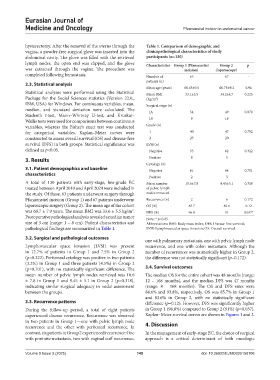
            pathological findings are summarized in Table 1.   LVSI: Lymphovascular space invasion; OS: Overall survival.
            3.2. Surgical and pathological outcomes
                                                               one with pulmonary metastasis, one with pelvic lymph node
            Lymphovascular  space  invasion  (LVSI)  was  present   recurrence, and one with colon metastasis. Although the
            in 12.7% of patients in Group  1 and 7.5% in Group  2   number of recurrences was numerically higher in Group 2,
            (p=0.322). Peritoneal cytology was positive in two patients   the difference was not statistically significant (p=0.172).
            (3.2%) in Group 1 and three patients (4.5%) in Group 2
            (p=0.701), with no statistically significant difference. The   3.4. Survival outcomes
            mean number of pelvic lymph nodes retrieved was 10.6   The median OS for the entire cohort was 48 months (range:
            ± 7.8 in Group  1 and 9.45 ± 5.1 in Group  2 (p=0.318),   12 – 168  months), and the median DFS was 47  months
            indicating similar surgical adequacy in nodal assessment   (range: 8 – 168  months). The OS and DFS rates were
            between the groups.                                84.6% and 93.8%, respectively. OS was 85.7% in Group 1
                                                               and 83.6% in Group  2, with no statistically significant
            3.3. Recurrence patterns                           difference (p=0.12). However, DFS was significantly higher

            During the follow-up period, a total of eight patients   in Group 1 (96.8%) compared to Group 2 (91%) (p=0.037).
            experienced disease recurrence. Recurrence was observed   Kaplan–Meier survival curves are shown in Figures 1 and 2.
            in two patients in Group 1—one with pelvic lymph node
            recurrence and the other with peritoneal recurrence. In   4. Discussion
            contrast, six patients in Group 2 experienced recurrence: One   In the management of early-stage EC, the choice of surgical
            with port-site metastasis, two with vaginal cuff recurrence,   approach is a critical determinant of both oncologic


            Volume 9 Issue 3 (2025)                        149                         doi: 10.36922/EJMO025150106

