


Page 158 - EJMO-9-3
P. 158
Eurasian Journal of
            Medicine and Oncology                                              Pfannenstiel incision in endometrial cancer


                                                               incision is well-established in gynecologic surgery, offering
                                                               favorable cosmetic outcomes, reduced postoperative pain,
                                                               and a lower risk of wound complications when compared to
                                                               vertical midline incisions. Several studies have highlighted
                                                               that this approach can provide sufficient access  to the
                                                               pelvic cavity while minimizing trauma to the abdominal
                                                               wall, potentially resulting in decreased rates of surgical
                                                               site infection and incisional hernia, particularly in obese
                                                               patients. Furthermore, the incision’s location along natural
                                                               skin folds contributes to improved patient satisfaction and
                                                               faster return to daily activities. 22,23  Laparoscopy plays an
                                                               important role in the surgical treatment of EC.  However,
                                                                                                    24
                                                               it may not be suitable for every patient. In some cases,
                                                               laparotomy may be more advantageous than laparoscopy.
                                                               We prefer laparotomy over laparoscopy in patients with
                                                               vaginal stenosis, morbid obesity that precludes safe trocar
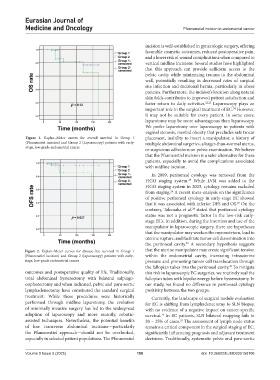
            Figure 1. Kaplan–Meier curves for overall survival in Group 1   placement, inability to insert a manipulator, a history of
            (Pfannenstiel incision) and Group 2 (Laparoscopy) patients with early-  multiple abdominal surgeries, a larger-than-normal uterus,
            stage, low-grade endometrial cancer
                                                               or suspicious adhesions on pelvic examination. We believe
                                                               that the Pfannenstiel incision is a safer alternative for these
                                                               patients, especially to avoid the complications associated
                                                               with midline incision.
                                                                 In 2009, peritoneal cytology was removed from the
                                                               FIGO staging system.  While LVSI was added to the
                                                                                 25
                                                               FIGO staging system in 2023, cytology remains excluded
                                                               from staging.  A recent meta-analysis on the significance
                                                                          26
                                                               of positive peritoneal cytology in early-stage EC showed
                                                               that it was associated with inferior DFS and OS.  On the
                                                                                                      27
                                                               contrary, Takenaka et al.  stated that peritoneal cytology
                                                                                   28
                                                               status was not a prognostic factor in the low-risk early-
                                                               stage ECs. In addition, during the insertion and use of the
                                                               manipulator in laparoscopic surgery, there are hypotheses
                                                               that the manipulator may weaken the myometrium, lead to
                                                               uterine rupture, and facilitate tumor cell dissemination into
                                                               the peritoneal cavity.  A secondary hypothesis suggests
                                                                                29
            Figure  2. Kaplan–Meier  curves for disease-free survival in Group 1   that the uterine manipulator may create significant tension
            (Pfannenstiel incision) and Group 2 (laparoscopy) patients with early-  within the endometrial cavity, increasing intrauterine
            stage, low-grade endometrial cancer                pressure and promoting tumor cell translocation through
                                                               the fallopian tubes into the peritoneal cavity.  To mitigate
                                                                                                   30
            outcomes and postoperative quality of life. Traditionally,   this risk in laparoscopic EC surgeries, we routinely seal the
            total  abdominal  hysterectomy  with  bilateral  salpingo-  fallopian tubes with bipolar energy before hysterectomy. In
            oophorectomy and when indicated, pelvic and para-aortic   our study, we found no difference in peritoneal cytology
            lymphadenectomy have constituted the standard surgical   positivity between the two groups.
            treatment. While these procedures were historically   Currently, the landscape of surgical nodule evaluation
            performed through midline laparotomy, the evolution   for EC is shifting from lymphadenectomy to SLN biopsy,
            of minimally invasive surgery has led to the widespread   with no evidence of a negative impact on cancer-specific
            adoption of laparoscopy and more recently, robotic-  survival.  In EC patients, SLN bilateral mapping fails in
                                                                      31
            assisted  techniques.  Nevertheless,  the  potential  benefits   20 – 25% of cases.  The assessment of lymph node status
                                                                              32
            of low transverse abdominal incisions—particularly   remains a critical component in the surgical staging of EC,
            the Pfannenstiel approach—should not be overlooked,   significantly influencing prognosis and adjuvant treatment
            especially in selected patient populations. The Pfannenstiel   decisions. Traditionally, systematic pelvic and para-aortic


            Volume 9 Issue 3 (2025)                        150                         doi: 10.36922/EJMO025150106

