


Page 51 - EJMO-9-3
P. 51
Eurasian Journal of
            Medicine and Oncology                                                  NOTCH3 in CSVD and breast cancer


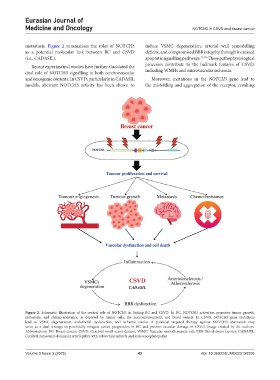
            metastasis.  Figure  2 summarises the roles of NOTCH3   induce VSMC degeneration, arterial wall remodelling
            as a potential molecular link between BC and CSVD   deficits, and compromised BBB integrity through increased
            (i.e., CADASIL).                                   apoptotic signalling pathways. 72,125  These pathophysiological
              Recent experimental studies have further elucidated the   processes contribute to the hallmark features of CSVD,
            dual role of NOTCH3 signalling in both cerebrovascular   including WMHs and microvascular ischemia.
            and oncogenic contexts. In CSVD, particularly in CADASIL   Moreover, mutations in the  NOTCH3 gene lead to
            models, aberrant NOTCH3 activity has been shown to   the misfolding and aggregation of the receptor, resulting


            Figure  2.  Schematic illustration of the central role of NOTCH3 in linking BC and CSVD. In BC, NOTCH3 activation promotes tumor growth,
            metastasis, and chemo-resistance, as depicted by tumor cells, the microenvironment, and blood vessels. In CSVD,  NOTCH3 gene mutations
            lead to VSMC degeneration, endothelial dysfunction, and ischemic stroke. A  potential targeted therapy against NOTCH3 aberration may
            serve as a dual strategy to potentially mitigate tumor progression in BC and prevent vascular damage in CSVD. Image created by the authors.
            Abbreviations: BC: Breast cancer; CSVD: Cerebral small vessel disease; VSMC: Vascular smooth muscle cell; BBB: Blood–brain barrier; CADASIL:
            Cerebral autosomal-dominant arteriopathy with subcortical infarcts and leukoencephalopathy.


            Volume 9 Issue 3 (2025)                         43                         doi: 10.36922/EJMO025150095

