


Page 174 - GHES-2-1
P. 174
Global Health Econ Sustain                                   Household food insecurity and Under-five Mortality


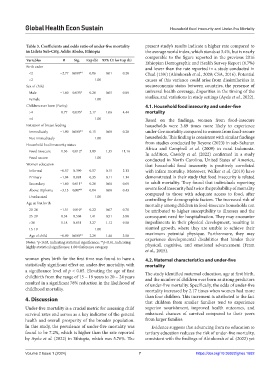
            Table 3. Coefficients and odds ratio of under‑five mortality   present study’s results indicate a higher rate compared to
            in Lideta Sub‑City, Addis Ababa, Ethiopia          the average world index, which stands at 3.4%, but is nearly
                                                               comparable to the  figure reported in the previous 2016
            Variables       B    Sig.   Exp (b)  95% CI for Exp (b)  Ethiopian Demographic and Health Survey Report (6.7%)
            Birth order                                        and lower than the rate reported in a study conducted in
             <2            −2.77 0.000**  0.06  0.01  0.28     Chad (13%) (Ahinkorah et al., 2020; CSA, 2016). Potential
             >2                          1.00                  causes of this variance could arise from dissimilarities in
            Sex of child                                       socioeconomic status between countries, the presence of
             Male          −1.60  0.035*  0.20  0.05  0.89     universal health coverage, disparities in the timing of the
             Female                      1.00                  studies, and variations in study settings (Ayele et al., 2022).
            Children ever born (Parity)                        4.1. Household food insecurity and under-five
             >4            0.77  0.035*  2.17  1.06  4.44      mortality
             <4                          1.00                  Based on the findings, women from food-insecure
            Initiation of breast feeding                       households were 3.89  times more likely to experience
             Immediately   −1.90 0.000**  0.15  0.08  0.28     under-five mortality compared to women from food-secure
             Not-immediately             1.00                  households. This finding is consistent with similar findings
            Household food insecurity status                   from studies conducted by Beyene (2023) in sub-Saharan
             Food-insecure  1.36  0.012*  3.89  1.35  11.16    Africa and Campbell  et al. (2009) in rural Indonesia.
                                                               In addition, Cassidy  et  al. (2022) confirmed in a study
             Food-secure                 1.00                  conducted in North Carolina, United States of America,
            Women education                                    that household food insecurity is positively correlated
             Informal      −0.57  0.399  0.57  0.15  2.13      with infant mortality. Moreover, Walker et al. (2019) have
             Primary       −1.04  0.081  0.35  0.11  1.14      demonstrated in their study that food insecurity is related
             Secondary     −1.60  0.011*  0.20  0.06  0.69     to adult mortality. They found that individuals reporting
             Above Diploma  −3.13  0.007**  0.04  0.00  0.43   severe food insecurity had twice the probability of mortality
                                                               compared to those with adequate access to food, after
             Uneducated                  1.00                  controlling for demographic factors. The increased risk of
            Age at first birth
                                                               mortality among children in food-insecure households can
             20-24         −1.51  0.010*  0.22  0.07  0.70     be attributed to higher susceptibility to illnesses and the
             25-29         0.34  0.504  1.41  0.51   3.88      consequent need for hospitalization. They may encounter
             >30           1.18  0.051  3.27  1.12   9.58      impediments in their physical development, resulting in
             15-19                       1.00                  stunted growth, where they are unable to achieve their
             Age of child  −0.89 0.000**  2.29  1.46  3.58     maximum potential physique. Furthermore, they may
                                                               experience developmental disabilities that hinder their
            Notes: *p<0.05, indicating statistical significance; **p<0.01, indicating   physical, cognitive, and emotional advancement (Fram
            highly statistical significance; 1.00=Reference category.
                                                               et al., 2015).
            woman gives birth for the first time was found to have a   4.2. Maternal characteristics and under-five
            statistically significant effect on under-five mortality, with   mortality
            a significance level of p < 0.05. Elevating the age of first   The study identified maternal education, age at first birth,
            childbirth from the range of 15 – 19 years to 20 – 24 years   and the number of children ever born as strong predictors
            resulted in a significant 78% reduction in the likelihood of   of under-five mortality. Specifically, the odds of under-five
            childhood mortality.                               mortality increased by 2.17 times when women had more
            4. Discussion                                      than four children. This increment is attributed to the fact
                                                               that children from smaller families tend to experience
            Under-five mortality is a crucial metric for assessing child   superior nourishment, improved health outcomes, and
            survival rates and serves as a key indicator of the general   enhanced chances of survival compared to their peers
            health and overall prosperity of the broader population.   from larger families.
            In this study, the prevalence of under-five mortality was   Evidence suggests that advancing from no education to
            found to be 7.2%, which is higher than the rate reported   tertiary education reduces the risk of under-five mortality,
            by Ayele et al. (2022) in Ethiopia, which was 5.76%. The   consistent with the findings of Ahinkorah et al. (2022) yet


            Volume 2 Issue 1 (2024)                         7                        https://doi.org/10.36922/ghes.1682

