


Page 66 - GHES-2-2
P. 66
Global Health Econ Sustain                                         Attributes of Ebola epidemic in West Africa


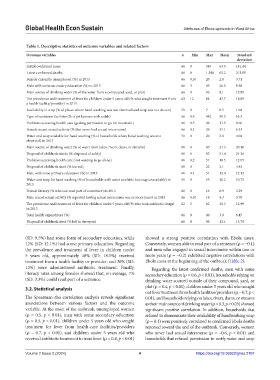
            Table 1. Descriptive statistics of outcome variables and related factors
            Outcome variables                                                 n    Min   Max   Mean   Standard
                                                                                                      deviation
            Initial confirmed cases                                           66  0      545  63.5   141.44
            Latest confirmed deaths                                           66  0      1,598  65.2  213.09
            Female currently unemployed (%) in 2013                           66  0.10   20   2.8    3.71
            Male with some secondary education (%) in 2013                    66  3      49   26.3   9.50
            Main source of drinking water (% of the water from a compound, yard, or plot)  66  0  45  8.1  12.89
            The prevalence and treatment of fever for children under 5 years old (% who sought treatment from   63  12  84  47.7  18.09
            a health facility/provider) in 2013
            Availability of soap (% of places where hand washing was not observed and soap was not shown)  51  0  7  0.5  1.04
            Type of sanitation facilities (% of pit latrines with a slab)     66  0.9    442  30.3   53.3
            Problems accessing health-care (getting permission to go for treatment)  66  0.5  49  11.3  9.66
            Female recent sexual activity (% that never had sexual intercourse)  66  0.3  26  11.1   6.33
            Water and soap available for hand washing (% of households where hand washing was not   51  0  20  3.8  4.04
            observed) in 2013
            Main source of drinking water (% of water from lakes, rivers, dams, or streams)  66  0  83  24.3  20.10
            Disposal of children’s stools (% disposed of safely)              66  6      93   51.0   24.36
            Problems accessing health care (not wanting to go alone)          66  0.2    51   18.5   12.05
            Disposal of children’s stool (% buried)                           66  0      22   3.1    4.85
            Male with some primary education (%) in 2013                      66  0.4    51   12.0   12.12
            Water and soap for hand washing (% of households with water available but soap unavailable) in   51  0  55  10.2  10.75
            2013
            Female literacy (% who can read part of a sentence) in 2013       66  0      16   6.9    3.29
            Male recent sexual activity (% reported having sexual intercourse one or more years) in 2013  66  0.10  18  5.3  3.70
            The prevalence and treatment of fever for children under 5 years old (% who took antibiotic drugs)   62  2  62  30.3  12.99
            in 2013
            Total health expenditure (%)                                      66  0      40   3.9    6.45
            Disposal of children’s stool (% left in the open)                 66  0      50   12.1   13.74


            (SD: 9.5%) had some form of secondary education, while   showed  a  strong  positive  correlation  with  Ebola  cases.
            12% (SD: 12.1%) had some primary education. Regarding   Conversely, women able to read part of a sentence (ρ = −0.1)
            the prevalence and treatment of fever in children under   and men who engaged in sexual intercourse within one or
            5  years old, approximately 48% (SD: 18.1%) received   more years (ρ = −0.2) exhibited negative correlations with
            treatment from a health facility or provider, and 30% (SD:   Ebola cases at the beginning of the outbreak (Table 2).
            13%) were administered antibiotic treatment. Finally,   Regarding the latest confirmed deaths,  men with some
            literacy rates among females showed that, on average, 7%   secondary education (ρ = 0.6, p < 0.01), households relying on
            (SD: 3.3%) could read part of a sentence.          drinking water sourced outside of their compound, yard, or

            3.2. Statistical analysis                          plot (ρ = 0.4, p < 0.01), children under 5 years old who sought
                                                               out fever treatment from health facilities/providers (ρ = 0.7, p <
            The Spearman rho correlation analysis reveals significant   0.01), and households relying on lakes, rivers, dams, or streams
            associations between various factors and the outcome   as their main source of drinking water (ρ = 0.3, p < 0.05) showed
            variable. At the onset of the outbreak, unemployed women   significant positive correlation. In addition, households that
            (ρ = 0.5, p < 0.01), men with some secondary education   refused to demonstrate their availability of handwashing soap
            (ρ = 0.5, p < 0.01), children under 5 years old who sought   (ρ = 0.1) were positively correlated to confirmed Ebola deaths
            treatment for fever from health-care facilities/providers   reported toward the end of the outbreak. Conversely, women
            (ρ = 0.7, p < 0.01), and children under 5 years old who   who never had sexual intercourse (ρ = −0.6, p < 0.01) and
            received antibiotic treatment to treat fever (ρ = 0.4, p < 0.01)   households that refused permission to verify water and soap


            Volume 2 Issue 2 (2024)                         4                        https://doi.org/10.36922/ghes.2107

