


Page 19 - GHES-2-4
P. 19
Global Health Economics and
            Sustainability
                                                                           COVID-19 and the burden on healthcare workers


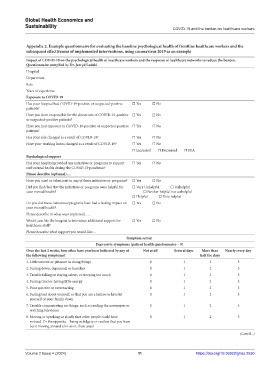
            Appendix 2. Example questionnaire for evaluating the baseline psychological health of frontline healthcare workers and the
            subsequent effectiveness of implemented interventions, using coronavirus 2019 as an example
            Impact of COVID‑19 on the psychological health of healthcare workers and the response of healthcare networks to reduce the burden.
            Questionnaire compiled by Dr. Jarryd Ludski
            Hospital
            Department
            Role
            Years of experience
            Exposure to COVID‑19
            Has your hospital had COVID-19-positive or suspected-positive   ☐ Yes             ☐ No
            patients?
            Have you been responsible for the direct care of COVID-19-positive  ☐ Yes             ☐ No
            or suspected-positive patients?
            Have you had exposure to COVID-19-positive or suspected-positive  ☐ Yes             ☐ No
            patients?
            Has your role changed as a result of COVID-19?  ☐ Yes             ☐ No
            Have your working hours changed as a result of COVID-19?  ☐ Yes             ☐ No
                                                         ☐ Increased        ☐ Decreased        ☐ N/A
            Psychological support
            Has your hospital provided any initiatives or programs to support   ☐ Yes             ☐ No
            staff mental health during the COVID-19 pandemic?
            Please describe (optional)….
            Have you used or taken part in any of these initiatives or programs?  ☐ Yes             ☐ No
            Did you find/feel that the initiatives or programs were helpful for   ☐ Very Unhelpful             ☐ Unhelpful
            your mental health?                                       ☐ Neither helpful nor unhelpful
                                                         ☐ Helpful             ☐ Very helpful
            Do you feel these initiatives/programs have had a lasting impact on   ☐ Yes             ☐ No
            your mental health?
            Please describe in what ways (optional)….
            Would you like the hospital to introduce additional support for   ☐ Yes             ☐ No
            healthcare staff?
            Please describe what support you would like…
                                                       Symptom screen
                                          Depressive symptoms (patient health questionnaire – 9)
            Over the last 2 weeks, how often have you been bothered by any of   Not at all  Several days  More than   Nearly every day
            the following symptoms?                                                   half the days
            1. Little interest or pleasure in doing things       0             1          2           3
            2. Feeling down, depressed, or hopeless              0             1          2           3
            3. Trouble falling or staying asleep, or sleeping too much  0      1          2           3
            4. Feeling tired or having little energy             0             1          2           3
            5. Poor appetite or overreacting                     0             1          2           3
            6.  Feeling bad about yourself, or that you are a failure or have let   0  1  2           3
              yourself or your family down
            7.  Trouble concentrating on things, such as reading the newspaper or   0  1  2           3
              watching television
            8.  Moving or speaking so slowly that other people could have   0  1          2           3
              noticed. Or the opposite – being so fidgety or restless that you have
              been moving around a lot more than usual
                                                                                                       (Cont’d...)


            Volume 2 Issue 4 (2024)                         11                       https://doi.org/10.36922/ghes.2530

