


Page 183 - GHES-3-2
P. 183
Global Health Economics and
            Sustainability
                                                                            Health awareness survey of university students


            in the survey: “Do you think it is useful for you to install   3.4. Willingness to participate in health promotion
            a bicycle repair station on campus with an air pump and   at university
            some basic gadgets for small repairs?’’ Three-quarters   The survey concluded by asking if students were interested
            of respondents reacted positively to this idea (Figure 13).   in actively participating in health promotion activities on
            This question was included to encourage university   campus, from idea collection and intervention design to
            management to initiate the bike repair station project.  implementation.
              On the topic of social well-being, students suggested   The smallest group consisted of students interested in
            organizing activities that foster social connections, such   such  actions  (7.7%),  who  provided  their  contact  details
            as gatherings during lunch breaks. Students who are also   for further collaboration on health promotion at Campus
            parents expressed the need for more support, including   Kleefeld.
            meetings for parents to connect and potentially assist each
            other with childcare, as well as a playroom on campus.  In contrast, almost half the respondents (48.8%)
                                                               expressed no interest. When asked why, the most common
              A recurring concern was the lack of communication
            about various interventions. Earlier survey questions   reason was a lack of time due to family life, studies, or work.
                                                               The second most frequent reason was a perceived lack of
            revealed that some interventions were unknown to students,   knowledge or expertise. Some students noted that there
            largely due to insufficient or invisible communication.   were no concrete benefits associated with participation,
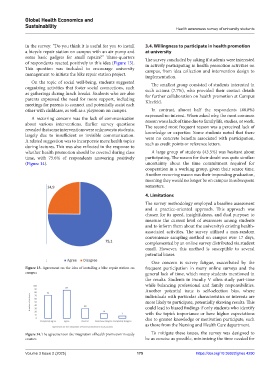
            A related suggestion was to incorporate more health topics   such as credit points or reference letters.
            during lectures. This was also reflected in the response to
            whether health promotion should be covered during class   A large group of students (43.5%) was hesitant about
            time, with  75.6%  of respondents answering  positively   participating. The reason for their doubt was quite similar:
            (Figure 14).                                       uncertainty about the time commitment required for
                                                               cooperation in a working group, given their scarce time.
                                                               Another recurring reason was their impending graduation,
                                                               meaning they would no longer be on campus in subsequent
                                                               semesters.

                                                               4. Limitations
                                                               The survey methodology employed a baseline assessment
                                                               and a practice-oriented approach. This approach was
                                                               chosen for its speed, insightfulness, and dual purpose: to
                                                               measure the current level of awareness among students
                                                               and to inform them about the university’s existing health-
                                                               associated activities. The survey utilized a non-random
                                                               convenience sampling method on campus over 17  days,
                                                               complemented by an online survey distributed via student
                                                               email. However, this method is susceptible to several
                                                               potential biases.
                                                                 One concern is survey fatigue, exacerbated by the
            Figure 13. Agreement on the idea of installing a bike repair station on   frequent participation in many online surveys and the
            campus                                             general lack of time, which many students mentioned in
                                                               the  results.  Students  in Faculty  V often  study  part-time
                                                               while  balancing  professional  and  family  responsibilities.
                                                               Another potential issue is self-selection bias, where
                                                               individuals with particular characteristics or interests are
                                                               more likely to participate, potentially skewing results. This
                                                               could lead to biased findings if only students who identify
                                                               with  the  topic’s  importance  or  have  higher  expectations
                                                               due to greater knowledge or motivation participate, such
                                                               as those from the Nursing and Health Care department.
            Figure 14. The agreement on the integration of health promotion in study   To mitigate these issues, the survey was designed to
            courses                                            be as concise as possible, minimizing the time needed for


            Volume 3 Issue 2 (2025)                        175                       https://doi.org/10.36922/ghes.4290

