


Page 180 - GHES-3-2
P. 180
Global Health Economics and
            Sustainability
                                                                            Health awareness survey of university students


            They were also presented with a range of six reasons for not
            participating in health-promoting activities on campus.
              All students from Faculty V of the Hannover University
            of Applied Sciences and Arts were eligible to participate in
            the online survey. Faculty V – Social Welfare and Health
            Care – is one of the five faculties of Hannover University
            of Applied Sciences and Arts, located at the Hannover-
            Kleefeld site. It offers five bachelor courses and three
            master courses. Students were invited to complete the
            survey through different recruitment methods: during
            seminars in the Nursing and Health Care department,
            through email to all students, and through social media.
            The Faculty V of Hannover University of Applied Sciences
            and Arts approved conducting the survey.
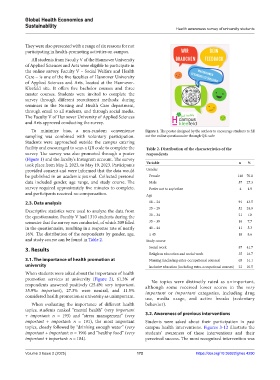
              To minimize bias, a non-random convenience       Figure 1. The poster designed by the authors to encourage students to fill
            sampling was combined with voluntary participation.   out the online questionnaire through QR code
            Students were approached outside the campus catering
            facility and encouraged to scan a QR code to complete the   Table 2. Distribution of the characteristics of the
            survey. The survey was also promoted through a poster   respondents
            (Figure 1) and the faculty’s Instagram account. The survey
            took place from May 2, 2023, to May 19, 2023. Participants   Variable                      n  %
            provided consent and were informed that the data would   Gender
            be published in an academic journal. Collected personal   Female                          148 70.8
            data included gender, age range, and study course. The   Male                              57  27.3
            survey required approximately five minutes to complete,   Prefer not to say/other          4  1.9
            and participants received no compensation.         Age
            2.3. Data analysis                                  18 – 24                                91  43.5
                                                                25 – 29                                52  24.9
            Descriptive statistics were used to analyze the data from
            the questionnaire. Faculty V had 1310 students during the   30 – 34                        21  10
            semester that the survey was conducted, of which 209 filled   35 – 39                      16  7.7
            in the questionnaire, resulting in a response rate of nearly   40 – 44                     11  5.3
            16%. The distribution of the respondents by gender, age,   ≥ 45                            18  8.6
            and study course can be found in Table 2.          Study course
            3. Results                                          Social work                            87  41.7
                                                                Religious education and social work    35  16.7
            3.1. The importance of health promotion at          Nursing (including extra-occupational courses)   65  31.1
            university                                          Inclusive education (including extra-occupational courses)  22  10.5
            When students were asked about the importance of health
            promotion services at university (Figure  2), 61.3% of   No topics were distinctly rated as unimportant,
            respondents answered positively (25.4%:  very important,   although some received lower scores in the  very
            35.9%:  important), 27.3% were neutral, and 11.5%   important or  important  categories, including drug
            considered health promotion at university as unimportant.  use, media usage, and active breaks (sedentary
              When  evaluating the  importance of  different  health   behavior).
            topics, students ranked “mental  health” (very important
            +  important: n = 193) and “stress management” (very   3.2. Awareness of previous interventions
            important +  important:  n = 191), the most important   Students were asked about their participation in past
            topics, closely followed by “drinking enough water” (very   campus health interventions.  Figures  3-12 illustrate the
            important + important: n = 190) and “healthy food” (very   students’ awareness of these interventions and their
            important + important: n = 184).                   perceived success. The most recognized intervention was


            Volume 3 Issue 2 (2025)                        172                       https://doi.org/10.36922/ghes.4290

