


Page 121 - GHES-3-3
P. 121
Global Health Economics and
            Sustainability
                                                                                            The challenges of caring


            obligation to provide care. Recognizing and supporting   sexual behavior in residents, which may be due to societal
            the intimate needs of patients is crucial, as is ensuring   taboos or inadequate preparation in their training
            that these needs are respected (Mattiasson & Hemberg,   (Roelofs et al., 2019).
            1998). Assessing the competency of patients for intimate   Nursing perspectives on intimacy and sexual behavior
            relationships is challenging due to the lack of standardized   in long-term  care settings reveal the  complexities
            guidelines (Lichtenberg & Strzepek, 1990).
                                                               of addressing these needs. While supporting sexual
            2. Nurses’ perspective                             expression can significantly enhance the well-being of
                                                               residents, nurses often face moral dilemmas and systemic
            Nurses play a critical role in supporting the intimate   barriers that  make  it  difficult  to  provide  this  support
            and sexual needs of individuals with dementia in long-  effectively.  Developing  clear  guidelines,  offering  targeted
            term care, yet they often face significant challenges in   training, and fostering a supportive organizational culture
            doing so. Intimacy is perceived by nurses as a complex   are essential steps toward improving the care of individuals
            concept,  encompassing not  only physical  closeness  but   with dementia in this regard.
            also emotional vulnerability, dependency, and trust. These
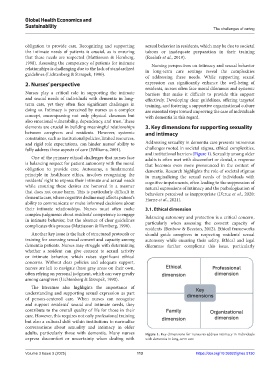
            elements are crucial in building meaningful relationships   3. Key dimensions for supporting sexuality
            between caregivers and residents. However, systemic   and intimacy
            constraints, such as institutional policies, limited resources,
            and rigid role expectations, can hinder nurses’ ability to   Addressing sexuality in dementia care presents numerous
            fully address these aspects of care (Williams, 2001).  challenges rooted in societal stigma, ethical complexities,
                                                               and institutional barriers (Figure 1). Sexuality among older
              One of the primary ethical challenges that nurses face   adults is often met with discomfort or denial, a response
            is balancing respect for patient autonomy with the moral   that  becomes  even  more  pronounced  in  the  context  of
            obligation to provide care. Autonomy, a fundamental   dementia. Research highlights the role of societal stigmas
            principle in healthcare ethics, involves recognizing the   in marginalizing the sexual needs of individuals with
            residents’ right to express their intimate and sexual needs   cognitive impairments, often leading to the suppression of
            while ensuring these desires are honored in a manner   natural expressions of intimacy and the pathologization of
            that does not cause harm. This is particularly difficult in   behaviors perceived as inappropriate (D’cruz et al., 2020;
            dementia care, where cognitive decline may affect a patient’s   Horne et al., 2021).
            ability to communicate or make informed decisions about
            their intimate relationships. Nurses must often make   3.1. Ethical dimension
            complex judgments about residents’ competency to engage   Balancing autonomy and protection is a critical concern,
            in intimate behavior, but the absence of clear guidelines   particularly when assessing the consent capacity of
            complicates this process (Mattiasson & Hemberg, 1998).
                                                               residents (Benbow & Beeston, 2012). Ethical frameworks
              Another key issue is the lack of structured protocols or   should guide caregivers in respecting residents’ sexual
            training for assessing sexual consent and capacity among   autonomy  while  ensuring  their  safety.  Ethical  and  legal
            dementia patients. Nurses may struggle with determining   dilemmas  further  complicate  this  issue,  particularly
            whether a resident can give consent to sexual activity
            or  intimate  behavior, which raises significant  ethical
            concerns. Without clear policies and adequate support,
            nurses are left to navigate these gray areas on their own,
            often relying on personal judgment, which can vary greatly
            among caregivers (Lichtenberg & Strzepek, 1990).

              The  literature  also  highlights the  importance of
            understanding and supporting sexual expression as part
            of person-centered care. When  nurses  can recognize
            and support residents’ sexual and intimate needs, they
            contribute to the overall quality of life for those in their
            care. However, this requires not only professional training
            but also a cultural shift within institutions to normalize
            conversations about sexuality and intimacy in older
            adults, particularly those with dementia. Many nurses   Figure 1. Key dimensions for nurses to address intimacy in individuals
            express discomfort or uncertainty when dealing with   with dementia in long-term care


            Volume 3 Issue 3 (2025)                        113                       https://doi.org/10.36922/ghes.5130

