


Page 198 - GHES-3-3
P. 198
Global Health Economics and
            Sustainability
                                                                           Blood exposure in Cameroon healthcare workers


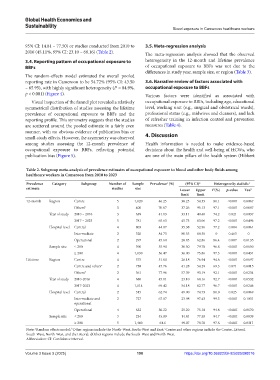
            95% CI: 14.81 – 77.50) or studies conducted from 2010 to   3.5. Meta-regression analysis
            2016 (45.11%, 95% CI: 23.10 – 68.16) (Table 2).
                                                               The meta-regression analysis showed that the observed
            3.4. Reporting pattern of occupational exposure to   heterogeneity in  the  12-month and  lifetime  prevalence
            BBFs                                               of occupational exposure to BBFs was not due to the
                                                               differences in study year, sample size, or region (Table 3).
            The random-effects model estimated the overall pooled
            reporting rate in Cameroon to be 54.72% (95% CI: 43.50   3.6. Narrative review of factors associated with
            – 65.95), with highly significant heterogeneity (I  = 84.9%,   occupational exposure to BBFs
                                                  2
            p < 0.001) (Figure 4).                             Various factors were identified as associated with
              Visual inspection of the funnel plot revealed a relatively   occupational exposure to BBFs, including age, educational
            symmetrical distribution of studies assessing the lifetime   level, working unit (e.g., surgical and obstetrical wards),
            prevalence  of  occupational  exposure  to  BBFs  and  the   professional status (e.g., midwives and cleaners), and lack
            reporting profile. This symmetry suggests that the studies   of refresher training in infection control and prevention
            are scattered around the pooled estimate in a fairly even   measures (Table 4).
            manner, with no obvious evidence of publication bias or
            small-study effects. However, the asymmetry was observed   4. Discussion
            among studies assessing the 12-month prevalence of   Health information is needed to make evidence-based
            occupational exposure to BBFs, reflecting potential   decisions about the health and well-being of HCWs, who
            publication bias (Figure 5).                       are one of the main pillars of the health system (Hibbert


            Table 2. Subgroup meta‑analysis of prevalence estimates of occupational exposure to blood and other body fluids among
            healthcare workers in Cameroon from 2010 to 2023
            Prevalence   Category   Subgroup   Number of   Sample   Prevalence  (%)  (95% CI) a  Heterogeneity statistic a
                                                                        a
            estimate                             studies  size                Lower   Upper   I (%)  p‑value  Tau 2
                                                                                            2
                                                                              limit  limit
            12-month  Region     Centre            5      1,020     46.25     38.25  54.35  80.1  ˂0.001  0.0067
                                 Others b          3       400      70.87     37.26  95.13  97.1  ˂0.001  0.0887
                      Year of study  2010 – 2016   3       639      41.13     33.11  49.40  74.2  0.021  0.0037
                                 2017 – 2023       5       781      65.63     45.73  83.06  97.2  ˂0.001  0.0496
                      Hospital level  Central      4       803      44.07     35.38  52.96  77.2  0.004  0.0061
                                 Intermediate      2       320      84.73     80.55  88.50   0    0.463   0
                                 Operational       2       297      45.60     28.85  62.86  86.4  0.007  0.0135
                      Sample size  ˂ 200           4       390      55.90     30.50  79.78  96.8  ˂0.001  0.0650
                                 ≥ 200             4      1,030     56.47     36.00  75.86  97.3  ˂0.001  0.0431
            Lifetime  Region     Centre            4       575      51.80     26.18  76.94  94.6  ˂0.001  0.0697
                                 Centre and others c  2    758      47.76     41.28  54.29  69.3  0.071  0.0015
                                 Others d          2       361      77.96     57.39  93.19  92.1  ˂0.001  0.0234
                      Year of study  2010-2016     4       680      45.11     23.10  68.16  92.7  ˂0.001  0.0532
                                 2017-2023         4      1,014     69.42     54.18  82.77  96.7  ˂0.001  0.0246
                      Hospital level  Central      2       315      62.74     49.90  74.73  80.0  0.025  0.0069
                                 Intermediate and   2      727      67.07     23.98  97.43  99.3  ˂0.001  0.1031
                                 operational
                                 Operational       4       652      50.22     25.20  75.18  94.8  ˂0.001  0.0670
                      Sample size  ˂ 200           3       234      45.09     14.81  77.50  94.7  ˂0.001  0.0839
                                 ≥ 200             5      1,460      64.6     49.07  78.70  97.6  ˂0.001  0.0311
            Note:  Random effects model;  Other regions include the North-West, South-West and East;  Centre and other regions include the Centre, Littoral,
                a
                                                                       c
                                b
            South-West, North-West, and the Littoral; dOther regions include the South-West and North-West.
            Abbreviation: CI: Confidence interval.
            Volume 3 Issue 3 (2025)                        190                 https://doi.org/10.36922/GHES025090016

