


Page 200 - GHES-3-3
P. 200
Global Health Economics and
            Sustainability
                                                                           Blood exposure in Cameroon healthcare workers


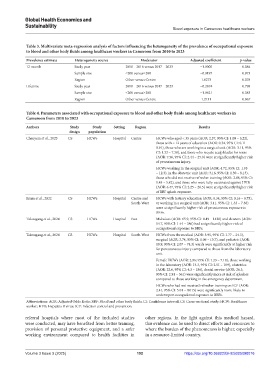
            Table 3. Multivariate meta‑regression analysis of factors influencing the heterogeneity of the prevalence of occupational exposure
            to blood and other body fluids among healthcare workers in Cameroon from 2010 to 2023
            Prevalence estimate  Heterogeneity source        Moderator            Adjusted coefficient  p‑value
            12-month             Study year           2010 – 2016 versus 2017 – 2023  −1.0005           0.084
                                 Sample size          ˂200 versus≥200                 −0.0197           0.973
                                 Region               Other versus Centre              1.0273           0.078
            Lifetime             Study year           2010 – 2016 versus 2017 – 2023  −0.2674           0.798
                                 Sample size          ˂200 versus≥200                 −1.0621           0.383
                                 Region               Other versus Centre              1.2131           0.067

            Table 4. Parameters associated with occupational exposure to blood and other body fluids among healthcare workers in
            Cameroon from 2010 to 2023
            Authors            Study    Study    Setting   Region                     Results
                               design  population
            Cheuyem et al., 2023  CS  HCWs       Hospital  Centre   HCWs who aged < 35 years (AOR: 2.37, 95% CI: 1.09 – 5.22),
                                                                   those with < 12 years of education (AOR: 0.34, 95% CI: 0.11 –
                                                                   0.91), those who are working in a surgical unit (AOR: 3.11, 95%
                                                                   CI: 1.33 – 7.38), and those who recycle scalp blades for reuse
                                                                   (AOR: 7.56, 95% CI: 2.44 – 25.9) were at significantly higher risk
                                                                   of percutaneous injury.
                                                                   HCWs working in the surgical unit (AOR: 4.72, 95% CI: 1.95
                                                                   – 12.3), in the obstetric unit (AOR: 3.16, 95% CI: 1.30 – 8.13),
                                                                   those who did not receive refresher training (AOR: 2.88, 95% CI:
                                                                   1.48 – 5.82), and those who were fully vaccinated against HVB
                                                                   (AOR: 6.47, 95% CI: 2.25 – 20.5) were at significantly higher risk
                                                                   of BBF splash exposure.
            Esum et al., 2022  CS     HCWs       Hospital  Centre and   HCWs with tertiary education (AOR: 0.34, 95% CI: 0.16 – 0.75),
                                                         South-West  or working in a surgical unit (AOR: 3.11, 95% CI: 1.33 – 7.38)
                                                                   were at significantly higher risk of percutaneous exposure to
                                                                   BBFs.
            Takougang et al., 2024  CS  HCWs     Hospital  East    Midwives (AOR: 65.9, 95% CI: 8.49 – 1428) and cleaners (AOR:
                                                                   14.7, 95% CI: 1.44 – 386) had a significantly higher risk of
                                                                   occupational exposure to BBFs.
            Takougang et al., 2024  CS  HCWs     Hospital  South-West  HCWs from the medical (AOR: 5.95, 95% CI: 1.77 – 24.3),
                                                                   surgical (AOR: 3.74, 95% CI: 1.06 – 15.7), and pediatric (AOR:
                                                                   10.9, 95% CI: 2.07 – 74.3) wards were significantly at higher risk
                                                                   for percutaneous injury compared to those from the laboratory
                                                                   unit.
                                                                   Female HCWs (AOR: 2.86; 95% CI: 1.23 – 7.18), those working
                                                                   in the laboratory (AOR: 13.3, 95% CI: 2.51 – 109), obstetrics
                                                                   (AOR: 22.6, 95% CI: 4.3 – 186), dental service (AOR: 26.3,
                                                                   95% CI: 2.91 – 361) were significantly more at risk of splashes
                                                                   compared to those working in the emergency department.
                                                                   HCWs who had not received refresher training on ICP (AOR:
                                                                   2.41, 95% CI: 5.01 – 0.015) were significantly more likely to
                                                                   underreport occupational exposure to BBFs.
            Abbreviations: AOR: Adjusted Odds Ratio; BBF: Blood and other body fluids; CI: Confidence interval; CS: Cross-sectional study; HCW: Healthcare
            worker; HVB: Hepatitis B virus; ICP: Infection control and prevention.

            referral hospitals where most of the included studies   other regions. In the  fight against this medical hazard,
            were conducted, may have benefited from better training,   this evidence can be used to direct efforts and resources to
            provision of personal protective equipment, and a safer   where the burden of the phenomenon is higher, especially
            working environment compared to health facilities in   in a resource-limited country.


            Volume 3 Issue 3 (2025)                        192                 https://doi.org/10.36922/GHES025090016

