


Page 34 - GHES-3-3
P. 34
Global Health Economics and
            Sustainability
                                                                                Semaglutide for treating T2D and obesity


            antidiabetic therapies has been linked to reduced mortality   situation is further exacerbated by a significant shortage of
            risk, particularly in elderly T2D patients (Rea et al., 2023).   semaglutide, partly driven by its increased use for weight
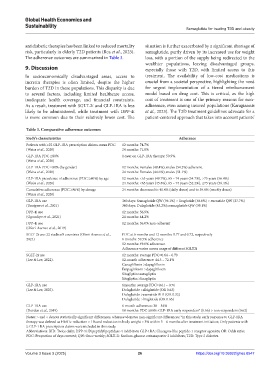
            The adherence outcomes are summarized in Table 3.  loss, with a portion of the supply being redirected to the
                                                               wealthier populations, leaving disadvantaged groups,
            9. Discussion                                      especially those with T2D, with limited access to this

            In socioeconomically disadvantaged areas, access to   treatment. The availability of low-cost medications is
            incretin therapies is often limited, despite the higher   crucial from a societal perspective, highlighting the need
            burden of T2D in these populations. This disparity is due   for urgent implementation of a tiered reimbursement
            to several factors, including limited healthcare access,   model based on drug cost. This is critical, as the high
            inadequate health coverage, and financial constraints.   cost of treatment is one of the primary reasons for non-
            As a result, treatment with SGLT-2i and GLP-1RA is less   adherence, even among insured populations (Karagiannis
            likely to be administered, while treatment with DPP-4i   et al., 2023). The T2D treatment guidelines advocate for a
            is  more  common  due  to  their  relatively  lower  cost.  The   patient-centered approach that takes into account patients’


            Table 3. Comparative adherence outcomes
            Study’s characteristics                                          Adherence
            Patients with ≥22 GLP-1RA prescription claims-mean PDC  12 months: 74.7%
            (Weiss et al., 2020)                     24 months: 71.8%
            GLP-1RA PDC ≥80%                         1-year on GLP-1RA therapy: 50.9%.
            (Weiss et al., 2020)
            GLP-1RA PDC ≥80% (by gender)             12 months: Females (48.4%); males (54.2%) adherent.
            (Weiss et al., 2020)                     24 months: Females (44.6%); males (51.1%)
            GLP-1RA prevalence of adherence (PDC ≥80%) by age  12 months: <65 years (49.7%), 65 – 74 years (54.7%), >75 years (56.4%)
            (Weiss et al., 2020)                     24 months: <65 years (45.8%), 65 – 74 years (52.2%), ≥75 years (56.4%)
            Cumulative adherence (PDC ≥80%) by dosage  24 months: decreased to 40.8% (daily doses) and to 59.8% (weekly doses)
            (Weiss et al., 2020)
            GLP-1RA use                              360 days: Semaglutide QW (39.1%) > liraglutide (30.0%) > exenatide QW (27.7%)
            (Uzoigwe et al., 2021)                   360 days: Dulaglutide (43.2%)=semaglutide QW (39.1%)
            DPP-4i use                               12 months: 56.9%
            (Ogundipe et al., 2021)                  24 months: 44.2%
            DPP-4i use                               12 months: 36.0% non-adherent
            (Ofori-Asenso et al., 2019)
            SGLT-2i use: 22 studies/8 countries (Ofori‐Asenso et al.,   PDC at 6 months and 12 months: 0.77 and 0.72, respectively
            2021)                                    6 months: 59.5% adherence
                                                     12 months: 49.0% adherence
                                                     Adherence varies across usage of different SGLT2i
            SGLT-2i use                              12 months: average PDC=0.64 – 0.79
            (Lee & Lee, 2022).                       12-month adherence: 44.3 – 72.1%
                                                     Canagliflozin >dapagliflozin
                                                     Empagliflozin >dapagliflozin
                                                     Sitagliptin=saxagliptin
                                                     Sitagliptin >linagliptin
            GLP-1RA use                              6months: average PDC=0.61 – 0.76
            (Lee & Lee, 2022).                       Dulaglutide >albiglutide (OR 0.63)
                                                     Dulaglutide >exenatide BID (OR 0.32)
                                                     Dulaglutide >liraglutide (OR 0.65)
            GLP-1RA use                              6-month adherence: 38 – 54%
            (Durden et al., 2019)                    18 months: PDC ≥80%: GLP-1RA early responders* (0.66) > non-responders (0.62)
            Notes: > and < denote statistically significant differences, whereas=denotes non-significant differences; *in this study, early response to GLP-1RA
            therapy was defined as HbA1c reduction > 1% and reduction in body weight > 3% within 3 – 6 months after treatment initiation; Only patients with
            ≥ GLP-1 RA prescription claims were included in this study.
            Abbreviations: BID: Twice daily; DPP-4i: Dipeptidyl peptidase-4 inhibitors; GLP-1RA: Glucagon-like peptide-1 receptor agonists; OR: Odds ratio;
            PDC: Proportion of days covered; QW: Once weekly; SGLT-2i: Sodium-glucose cotransporter 2 inhibitors; T2D: Type 2 diabetes.


            Volume 3 Issue 3 (2025)                         26                       https://doi.org/10.36922/ghes.8547

