


Page 33 - GHES-3-3
P. 33
Global Health Economics and
            Sustainability
                                                                                Semaglutide for treating T2D and obesity


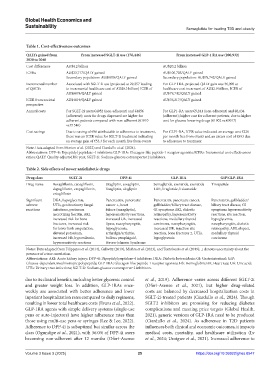
            Table 1. Cost‑effectiveness outcomes
            QALYs gained from       From increased SGLT‑2i use (176,446)    From increased GLP‑1 RA use (200,932)
            2020 to 2040
            Cost differences  AU$4.2 billion                          AU$20.2 billion
            ICERs            AU$23,717/QALY gained                    AU$100,705/QALY gained
                             Secondary population: AU$8878/QALY gained  Secondary population: AU$79,742/QALY gained
            Incremental number   Associated with SGLT-2i use (projected at 29,357 leading   For GLP-1RA, projected QALY gain was 36,090 at
            of QALYs         to incremental healthcare cost of AU$0.3 billion) ICER of   healthcare cost increment of AU$2.9 billion, ICER of
                             AU$8878/QALY gained                      AU$79,742/QALY gained
            ICER from societal   AU$4819/QALY gained                  AU$76,217/QALY gained
            perspective
            Annual costs     For SGLT-2i users:€4952 (non-adherent) and €4856   For GLP1-RA users:€5,241 (non-adherent) and €6,134
                             (adherent); costs for drugs dispensed are higher for   (adherent); higher cost for adherent patients, due to higher
                             adherent patients compared with non-adherent (€1910   cost for glucose-lowering drugs (€1902 vs.€3017)
                             vs.€1546)
            Cost savings     Due to saving of €96 attributable to adherence to treatment,   For GLP1-RA, ICER value indicated an average cost €228
                             there was an ICER value for SGLT-2i treatment indicating   per month free from events and an excess cost of €893 due
                             an average gain of €53.3 for each month free from events  to adherence to treatment
            Note: Data adapted from Morton et al. (2022) and Ciardullo et al. (2024).
            Abbreviations: DPP-4i: Dipeptidyl peptidase-4 inhibitors; GLP-1RA: Glucagon-like peptide-1 receptor agonists; ICERs: Incremental cost-effectiveness
            ratios; QALY: Quality-adjusted life year; SGLT-2i: Sodium-glucose cotransporter 2 inhibitors.

            Table 2. Side effects of newer antidiabetic drugs
            Drug class        SGLT‑2i               DPP‑4i                GLP‑1RA              GIP/GLP‑1RA
            Drug name   Bexagliflozin, canagliflozin,   Sitagliptin, saxagliptin,   Semaglutide, exenatide, exenatide   Tirzepatide
                        dapagliflozin, empagliflozin,   linagliptin, alogliptin  LAR, liraglutide, lixisenatide
                        ertugliflozin
            Significant   DKA, hypoglycemia,   Pancreatitis, pancreatic   Pancreatitis, pancreatic cancer,   Pancreatitis, gallbladder/
            adverse     UTIs, genitourinary fungal   cancer ±, heart   gallbladder/biliary tract disease,   biliary tract disease, GI
            reactions   infections, perineum   failure (saxagliptin),   GI symptoms AKI, diabetic   symptoms hypersensitivity
                        necrotizing fasciitis, AKI,   hypersensitivity reactions,   retinopathy, hypersensitivity   reactions, site reaction,
                        increased risk for bone   increased UA, increased   reactions, medullary thyroid   hypoglycemia,
                        fractures, increased risk   lipase, nasopharyngitis,   carcinoma, nasopharyngitis,   nasopharyngitis, diabetic
                        for lower limb amputation,   hypoglycemia,   increased HR, injection site   retinopathy, AKI, alopeci,
                        elevated potassium,   arthralgia/arthritis,   reaction, bone fractures ±, UTIs,   medullary thyroid
                        increased Hb, hypovolemia,   bullous pemphigoid,   hypoglycemia    carcinoma
                        hypersensitivity reactions  Steven-Johnson Syndrome
            Notes: Data adapted from Filippatos et al. (2014), Gallwitz (2019), Mishra et al. (2023), and Tentolouris et al. (2019); ± denotes uncertainty about the
            presence of a true correlation.
            Abbreviations: AKI: Acute kidney injury; DPP-4i: Dipeptidyl peptidase-4 inhibitors; DKA: Diabetic ketoacidosis; GI: Gastrointestinal; GIP:
            Glucose-dependent insulinotropic polypeptide; GLP-1RA: Glucagon-like peptide-1 receptor agonists; Hb: Hemoglobin; HR: Heart rate; UA: Uric acid;
            UTIs: Urinary tract infections; SGLT-2i: Sodium-glucose cotransporter 2 inhibitors.

            due to its clinical benefits, including better glycemic control   et al., 2019). Adherence varies across different SGLT-2i
            and greater weight loss. In addition, GLP-1RAs once-  (Ofori‐Asenso  et al., 2021), but higher drug-related
            weekly are associated with better adherence and lower   costs are balanced by decreased hospitalization costs in
            inpatient hospitalization rates compared to daily regimens,   SGLT-2i-treated patients (Ciardullo et al., 2024). Though
            resulting in lower total healthcare costs (Evans et al., 2022).   SGLT2 inhibitors are promising for reducing diabetes
            GLP-1RA agents with simple delivery systems (single-use   complications and meeting price targets (Global Health,
            pens or auto-injectors) have higher adherence rates than   2021), generic versions of GLP-1RA need to be produced
            those using multi-use pens or syringes (Lee & Lee, 2022).   (Ciardullo  et al., 2024). As adherence in T2D patients
            Adherence to DPP-4i is suboptimal but similar across the   influences both clinical and economic outcomes, it impacts
            class (Ogundipe et al., 2021), with 36.0% of DPP-4i users   medical costs, mortality, and healthcare utilization (Lv
            becoming non-adherent after 12  months (Ofori-Asenso   et al., 2024; Uzoigwe et al., 2021). Increased adherence to


            Volume 3 Issue 3 (2025)                         25                       https://doi.org/10.36922/ghes.8547

