


Page 76 - GTM-1-1
P. 76
Global Translational Medicine                                   ctDNA in management of patients with NSCLC


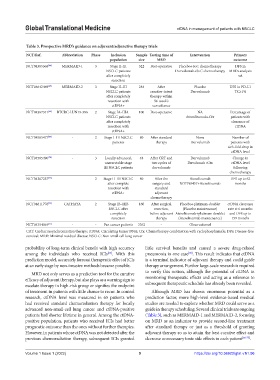
            Table 3. Prospective MRD’s guidance on adjuvant/adjunctive therapy trials
            NCT/Ref.       Abbreviation  Phase  Inclusion   Sample  Testing time of   Intervention  Primary
                                                population  size    MRD                             outcome
            NCT04385368 [66]  MERMAID-1  3      Stage II-III   322  Post-operative  Placebo+SoC chemotherapy  DFS in
                                              NSCLC patients                Durvalumab+SoC chemotherapy  MRD+analysis
                                              after completely                                        set
                                                resection
            NCT04642469 [67]  MERMAID-2  3      Stage II–III   284  After           Placebo        DFS in PD-L1
                                              NSCLC patients     curative-intent   Durvalumab        TC≥1%
                                              after completely   therapy within
                                               resection with      96-week’s
                                                 ctDNA+           surveillance
            NCT04367311 [68]  BTCRC-LUN19-396  2  Stage IA–IIIA   100  Post-operative  NA          Percentage of
                                              NSCLC patients                    Atezolizumab+Ctx   patients with
                                              after completely                                     clearance of
                                               resection with                                        ctDNA
                                                 ctDNA+
            NCT04585477 [69]    -        2   Stage I–III NSCLC   80  After standard   None          Number of
                                                 patients          therapy        Durvalumab       patients with
                                                                                                  a≥3-fold drop in
                                                                                                   ctDNA level
            NCT04585490 [70]    -        3    Locally advanced,   48  After CRT and   Durvalumab    Change in
                                              unresectable stage   two cycles of   Duvalumab+Ctx   ctDNA level
                                             III NSCLC patients   durvalumab                        following
                                                                                                   chemotherapy
            NCT04267237 [72]    -        2   Stage II–III NSCLC   80  After the   Atezolizumab     DFS up to 62
                                               after complete     surgery and   RO7198457+Atezolizumab  months
                                               resection with      standard
                                                 ctDNA+            adjuvant
                                                                 chemotherapy
            NCT04611776 [73]  CATHAYA    2     Stage IB–IIIB   160  After surgical   Placebo+platinum-doublet   ctDNA clearance
                                               NSCLC after         resection,   (Placebo maintenance)  rate at 6 months
                                                completely       before adjuvant  Atezolizumab+platinum-doublet   and DFS up to
                                                resection          therapy   (Atezolizumab maintenance)  159 months
            NCT04354064 [71]    -         -  Pan cancer patients  3362  -         Observational        -
            CRT: Cardiac resynchronization therapy; ctDNA: Circulating tumor DNA; Ctx: Chemotherapy combination with cyclophosphamide; DFS: Disease-free
            survival; MRD: Minimal residual disease; NSCLC: Non-small cell lung cancer

            probability of long-term clinical benefit with high accuracy   little survival benefits and caused a severe drug-related
            among the individuals who received ICIs . With this   pneumonia in one case . This result indicates that ctDNA
                                               [64]
                                                                                 [65]
            prediction model, accurately forecast therapeutic effect of ICIs   is a terminal indicator of adjuvant therapy and could guide
            at an early stage by non-invasive methods became possible.  therapy arrangement. Further large-scale research is required
              MRD not only serves as a prediction tool for the curative   to verify this notion, although the potential of ctDNA in
            efficacy of adjuvant therapy, but also plays as a warning sign to   monitoring therapeutic effects and acting as a reference to
            escalate therapy in high-risk group or signifies the endpoint   subsequent therapeutic schedule has already been revealed.
            of treatment in patients with little chance to recur. In control   Although MRD has shown enormous potential as a
            research, ctDNA level was measured in 65  patients who   prediction  factor,  more  high-level  evidence-based  medical
            had received standard chemoradiation therapy for locally   studies are needed to explore whether MRD could serve as a
            advanced non-small-cell lung cancer and ctDNA-positive   guide in therapy scheduling. Several clinical trials are ongoing
            patients had shorter lifetime in general. Among the ctDNA-  (Table 3), such as MERMAID-1 and MERMAID-2, focusing
            positive population, patients who received ICIs had better   on MRD as an indicator to provide second-line treatment
            prognostic outcome than the ones without further therapies.   after standard therapy or just as a threshold of granting
            However, in patients whose ctDNA was not detected after the   adjuvant therapy so as to attain the best curative effect and
            previous chemoradiation therapy, subsequent ICIs granted   decrease unnecessary toxic side effects in each patient [66-73] .


            Volume 1 Issue 1 (2022)                         9                       https://doi.org/10.36922/gtm.v1i1.96

