


Page 82 - GTM-1-1
P. 82
Global Translational Medicine                                              Quantification of atherosclerosis


            2. En face analysis of atherosclerotic lesions     A        B
                                                                                   C
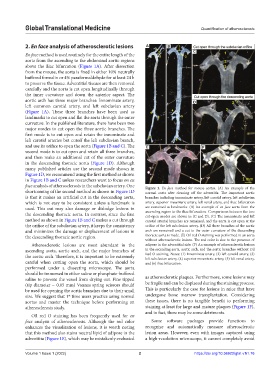
            En face method is used routinely for the entire length of the
            aorta from the ascending to the abdominal aortic regions
            above the iliac bifurcation (Figure  1A). After dissection
            from the mouse, the aorta is fixed in either 10% neutrally
            buffered formalin or 4% paraformaldehyde for at least 24 h
            to preserve the tissue. Adventitial tissues are then removed
            carefully and the aorta is cut open longitudinally through
            the inner curvature and down the anterior aspect. The
            aortic arch has three major branches: Innominate artery,               D
            left common carotid artery, and left subclavian artery
            (Figure  1A). These three branches have been used as
            landmarks to cut open and flat the aorta through the outer
            curvature. In the published literature, there have been two
            major modes to cut open the three aortic branches. The
            first mode is to cut open and retain the innominate and
            left carotid arteries but cutoff the left subclavian branch,
            and use its orifice to open the aorta (Figure 1B and C). The   E           F
            second mode is to cut open and retain all three branches,
            and then make an additional cut of the outer curvature
            in the descending thoracic aorta (Figure  1D). Although
            many published articles use the second mode shown in
            Figure 1D, we recommend using the first method as shown
            in Figure 1B and C unless researchers want to focus on en
            face analysis of atherosclerosis in the subclavian artery. One   Figure  1.  En  face method for mouse aortas. (A) An example  of the
            shortcoming of the second method as shown in Figure 1D   normal aorta after cleaning off the adventitia: The important aortic
            is that it makes an artificial cut in the descending aorta,   branches including innominate artery, left carotid artery, left subclavian
            which is not easy to be consistent unless a landmark is   artery, superior mesenteric artery, left renal artery, and iliac bifurcation
            used. This cut may also damage or dislodge lesions in   are remained as landmarks. (B) An example of en face aorta from the
            the descending thoracic aorta. In contrast, since the first   ascending region to the iliac bifurcation. Comparisons between the two
                                                               cut-open modes are shown in (C and D). (C) The innominate and left
            method as shown in Figure 1B and C makes a cut through   carotid arterial branches are remained, and the aorta is cut open at the
            the orifice of the subclavian artery, it keeps the consistency   orifice of the left subclavian artery. (D) All three branches of the aortic
            and minimizes the damage or displacement of lesions in   arch are remained and a cut to the outer curvature of the descending
            the descending thoracic aortic region.             thoracic aorta is made. (E) Oil red O staining was performed in an aorta
                                                               without atherosclerotic lesions. The red color is due to the presence of
              Atherosclerotic lesions are most abundant in the   adipose in the adventitial side. (F) An example of atherosclerotic lesions
            ascending aorta, aortic arch, and the major branches of   in the ascending aorta, aortic arch, and the aortic branches without Oil
            the aortic arch. Therefore, it is important to be extremely   Red O staining. Notes: (1) Innominate artery, (2) left carotid artery, (3)
                                                               left subclavian artery, (4) superior mesenteric artery, (5) left renal artery,
            careful when cutting open the aorta, which should be   and (6) iliac bifurcation.
            performed under  a dissecting  microscope. The aorta
            should be immersed in either saline or phosphate-buffered
            saline to prevent the vessel from drying out. Fine tipped   as atherosclerotic plaques. Furthermore, some lesions may
            (tip diameter ~ 0.05 mm) Vannas spring scissors should   be fragile and can be displaced during the staining process.
            be used for opening the aortic branches due to their small   This is particularly the case for lesions in mice that have
            size. We suggest that 1  time users practice using normal   undergone bone marrow transplantation. Considering
                              st
            aortas and master the technique before performing an   these issues, there is no tangible benefit to performing
            atherosclerosis study.                             staining at least for large and mature plaques (Figure 1F),
                                                               and in fact, there may be some detriments.
              Oil red O staining has been frequently used for  en
            face analysis of atherosclerosis. Although the red color   Some software packages provide functions to
            enhances the visualization of lesions, it is worth noting   recognize and automatically measure atherosclerotic
            that this method also stains neutral lipid of adipose in the   lesion  areas.  However,  even  with  images  captured  using
            adventitia (Figure 1E), which may be mistakenly evaluated   a high-resolution microscope, it cannot completely avoid


            Volume 1 Issue 1 (2022)                         2                       https://doi.org/10.36922/gtm.v1i1.76

