


Page 75 - GTM-2-2
P. 75
Global Translational Medicine                                          Elastolysis of porcine aortic adventitia


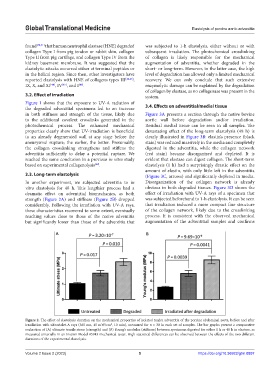
            found [40,41]  that human neutrophil elastase (HNE) degraded   was subjected to 1-h elastolysis, either without or with
            collagen Type I from pig tendon or rabbit skin, collagen   subsequent irradiation. The photochemical crosslinking
            Type II from pig cartilage, and collagen Type IV from the   of collagen is likely responsible for the mechanical
            kidney basement membrane. It was suggested that the   augmentation of adventitia, whether degraded in the
            elastolytic attacks occurred either at terminal peptides or   short- or long-term. However, in the latter case, the high
            in the helical region. Since then, other investigators have   level of degradation has allowed only a limited mechanical
            reported elastolysis with HNE of collagens types III [42,43] ,   recovery. We can only conclude that such extensive
            IX, X, and XI , IV , and I .                       enzymolytic damage can be explained by the degradation
                      [44]
                           [45]
                                   [46]
                                                               of collagen by elastase, as no collagenase was present in the
            3.2. Effect of irradiation                         system.
            Figure  1  shows  that  the  exposure  to  UV-A  radiation  of
            the degraded adventitial specimens led to an increase   3.4. Effects on adventitial/medial tissue
            in both stiffness and strength of the tissue, likely due   Figure 3A presents a section through the native bovine
            to the additional covalent crosslinks generated in the   aortic wall before degradation and/or irradiation.
            photochemical process. The enhanced mechanical     Residual  medial  tissue  can  be  seen  in  all  samples.  The
            properties clearly show that UV-irradiation is  beneficial   devastating effect of the long-term elastolysis (48  h) is
            to an already degenerated wall at any stage before the   clearly illustrated in Figure 3B: elastin’s presence (black
            aneurysmal rupture; the earlier, the better. Presumably,   stain) was reduced massively in the media and completely
            the collagen crosslinking strengthens and stiffens the   digested in the adventitia, while the collagen network
            adventitia sufficiently to delay a potential rupture. We   (red stain) became disorganized and depleted. It is
            reached the same conclusion in a previous in vitro study   evident that elastase can digest collagen. The short-term
            based on experimental collagenolysis .             elastolysis (1 h) had a surprisingly drastic effect on the
                                         [22]
                                                               amount of elastin, with only little left in the adventitia
            3.3. Long-term elastolysis                         (Figure 3C, arrows) and significantly depleted in media.
            In another experiment, we subjected adventitia to  in   Disorganization of  the  collagen network  is already
            vitro elastolysis for 48  h. This lengthier process had a   obvious in both degraded tissues. Figure 3D shows the
            dramatic  effect on  adventitial biomechanics,  as both   effect of irradiation with UV-A rays of a specimen that
            strength  (Figure  2A)  and  stiffness  (Figure  2B)  dropped   was subjected beforehand to 1-h elastolysis. It can be seen
            considerably. Following the irradiation with UV-A rays,   that irradiation induced a more compact fine structure
            these characteristics recovered to some extent, eventually   of the collagen network, likely due to the crosslinking
            reaching values close to those of the native adventitia   process. It is consistent with the observed mechanical
            but significantly lower than those of the adventitia that   augmentation of the adventitial samples and confirms

                         A                                     B


            Figure 2. The effect of elastolysis duration on the mechanical properties of isolated tunica adventitia of the porcine abdominal aorta, before and after
            irradiation with ultraviolet-A rays (365 nm, 45 mW/cm , 10 min), measured for n = 30 in each set of samples. The bar graphs present a comparative
                                                2
            evaluation of (A) ultimate tensile stress (strength) and (B) Young’s modulus (stiffness) between specimens digested for either 1 h or 48 h in elastase, as
            measured uniaxially in an Instron Model #5943 mechanical tester. High statistical differences can be observed between the effects of the two different
            durations of the experimental elastolysis.

            Volume 2 Issue 2 (2023)                         5                        https://doi.org/10.36922/gtm.0897

