


Page 74 - GTM-2-2
P. 74
Global Translational Medicine                                          Elastolysis of porcine aortic adventitia


            lesser extent — for applying it to ex vivo arterial tissues [26-35] .   Even though collagen can be degraded by elastase,
            Both  animal and  human (post-mortem)  arterial tissues   duration of 1 h may be too short to affect its quantity and
            have been used in these investigations, and results   structural organization, and our study has looked into
            were variable, even conflicting at times, depending on   this. Dobrin and Canfield  were the first to discuss the
                                                                                    [26]
            experimental conditions such as duration of exposure to an   possibility that both elastin and collagen could be degraded
            enzyme, concentration of enzyme, and species variability.   by the two enzymes, which they were afraid might have
            Nevertheless, the consensus is that collagen is responsible   a bearing on the interpretation of results. However, they
            for the strength and stiffness of the vessel, while elastin   believed that such overlap did not influence the outcome of
                                                                                               [34]
            imparts extensibility,  compliance,  and elastic  recoil,  all   their experiments. In a more recent study , post-elastolysis
            these being the consequences of the intrinsic properties of   disorganization of the collagen fibers was attributed to the
            these two biological materials [36,37] . It was also determined   removal of the intertwined elastin lamellae, ignoring a
            that collagenolysis reduces the strength and stiffness of   possible partial elastolysis of collagen.
            arterial walls  [27,29] . Regarding the elastolysis of adventitia,   The issue of collagen being a substrate for elastase
                                                   [31]
            some  researchers  noticed  no  effect  on  stiffness ,  while   deserves further consideration, as — rather surprisingly
            others noticed its increase .                      — this topic has previously generated little interest.
                                 [32]
                                                                                              [38]
            3.1. Short-term elastolysis                        In earlier research, Baló and Banga  isolated certain
                                                               bioactive products from the porcine pancreas, including
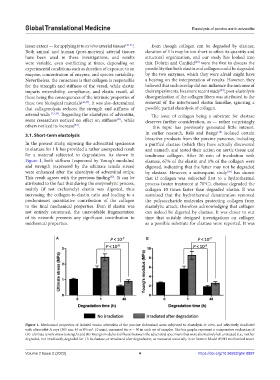
            In the present study, exposing the adventitial specimens   a purified elastase (which they have actually discovered
            to elastase for 1 h has provided a rather unexpected result   and named), and tested their action on aortic tissue and
            for a material subjected to degradation. As shown in   tendinous collagen. After 30  min of incubation with
            Figure 1, both stiffness (expressed by Young’s modulus)   elastase, 67% of the elastin and 1% of the collagen were
            and strength (expressed by the ultimate tensile stress)   digested, indicating that the latter may not be degraded
            were enhanced after the elastolysis of adventitial strips.   by elastase. However, a subsequent study  has shown
                                                                                                  [39]
            This result agrees with the previous finding . It can be   that if collagen was subjected first to a hydrothermal
                                                [32]
            attributed to the fact that during the enzymolytic process,   process (water treatment at 70°C), elastase degraded the
            mainly  (if  not  exclusively)  elastin  was  digested,  thus   collagen 10  times faster than degraded elastin. It was
            increasing the collagen-to-elastin ratio and leading to a   surmised that the hydrothermal denaturation removed
            predominant quantitative contribution of the collagen   the polysaccharide molecules protecting collagen from
            to the final mechanical properties. Even if elastin was   elastolytic attack, therefore acknowledging that collagen
            not entirely consumed, the unavoidable fragmentation   can indeed be digested by elastase. It was closer to our
            of its network prevents any significant contribution to   time that suitably designed investigations on collagen
            mechanical properties.                             as a possible substrate for elastase were reported. It was


                         A                                     B


            Figure 1. Mechanical properties of isolated tunica adventitia of the porcine abdominal aorta subjected to elastolysis in vitro, and selectively irradiated
            with ultraviolet-A rays (365 nm, 45 mW/cm , 10 min), measured for n = 30 in each set of samples. The bar graphs represent a comparative evaluation of
                                        2
            (A)  ultimate tensile stress (strength) and (B) Young’s modulus (stiffness) between the adventitial specimens that were alternatively left untreated (i.e., neither
            degraded, nor irradiated), degraded for 1 h in elastase, or irradiated after degradation, as measured uniaxially in an Instron Model #5943 mechanical tester.

            Volume 2 Issue 2 (2023)                         4                        https://doi.org/10.36922/gtm.0897

