


Page 7 - IJB-4-1
P. 7
3D printing for drug manufacturing: A perspective on the future of pharmaceuticals

           printing of viscous materials. Extrusion printing is ano-  needs. Conventional drug manufacturing methods lack
           ther alternative method which is compatible with both   the ability to fulfill this necessity, as they focus on
           viscous and solid materials. Furthermore, drug products   large-scale batches [26] . There is little flexibility in the
           can be printed using hydrogels or polymer-based fila-  typical manufacturing process, requiring several steps
                [1]
           ments .                                             which would be too difficult to tailor for a small batch.
            The rationales supporting the increasing research in   Conversely, 3D printing-based fabrication of drug
           3D printing for drug manufacturing are noteworthy. In   pro ducts can be changed between prescriptions, also
           general, there is a demand for adaptability, a feature that   showing promise to transform pharmacy compounding.
           is not often seen in pharmaceuticals [26] . This includes   Herein, we provide a case for the exploration of 3D
           the ability to fabricate dosage forms with complex geo-  printing for drug manufacturing. We first review 3D
           metries and architectures, which directly correlates   printing methods and materials that are applicable to
           to increased complexity and control over release cha-  drug manufacturing. Then, we elaborate on the benefits
           racteristics. The adaptability of 3D printing may also   of this developing approach in pharmaceuticals,
           be applied for the precise and unique dosing of drugs,   justifying why the FDA has encouraged continued
           whereby drug doses can be printed with the safety of   de velopment of 3D printed products [1,21] . We see the
           digital control. Additionally, multiple doses or multiple   3D printing of drug products as the next imminent
           drugs can be printed together in a singular dosage form.   revolution in the medicine and healthcare industries, and
           Finally and importantly, 3D printing allows for drug   aim to demonstrate it as such.
           products to be adapted for on-demand, prescription-  2. Applicable 3D Printing Methods
           specific production. The ability of on-the-spot drug
           fabrication will have major implications in emergency   For the purposes of printing drug products, we are
           medicine and for medications with limited shelf-life .   concerned with 3D printing technology which utilizes
                                                         [1]
           Furthermore, 3D printing of drugs means that they   bio-compatible materials that incorporate pharmaceutical
           can be manufactured for patients on an individualized   elements. There are numerous 3D printing methods,
           basis. This capacity directly responds to the demand   many of which have previously been reported as adapted
                                                 [1]
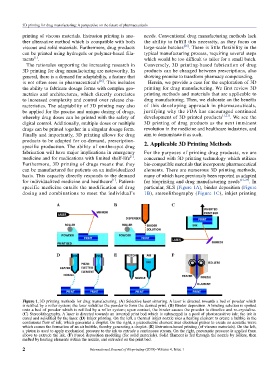
           for individualized medicine and healthcare . Patient-  for bioprinting and drug manufacturing needs [23–25] . In
           specific medicine entails the modification of drug   particular, SLS (Figure 1A), binder deposition (Figure
           dosing and combinations to meet the individual’s    1B), stereolithography (Figure 1C), inkjet printing


                         A                        B                       C


                         D                        E                       F


           Figure 1. 3D printing methods for drug manufacturing. (A) Selective laser sintering. A laser is directed towards a bed of powder which
           is refilled by a roller system; the laser solidifies the powder to form the desired print. (B) Binder deposition. A binding solution is spotted
           onto a bed of powder which is refilled by a roller system; upon contact, the binder causes the powder to dissolve and re-crystalize.
           (C) Stereolithography. A laser is directed towards an inverted print bed which is submerged in a pool of photosensitive ink; the ink is
           cured and solidified by the laser. (D) Inkjet printing. On the left, a thermal inkjet nozzle uses a heating element to create a bubble in the
           continuous flow of ink, which generates a droplet. On the right, a piezoelectric element uses electrical pulses to create an acoustic wave
           which causes the formation of an air bubble, thereby generating a droplet. (E) Extrusion-based printing (of viscous materials). On the left,
           a piston is used to apply mechanical pressure to the ink to extrude a continuous stream. On the right, pneumatic pressure is applied from
           above to extrude the ink. (F) Fused deposition modeling (for solid materials). Solid filament is fed through the nozzle by rollers, then
           melted by heating elements within the nozzle, and extruded on the print bed.

           2                           International Journal of Bioprinting (2018)–Volume 4, Issue 1

