


Page 586 - IJB-10-4
P. 586
International Journal of Bioprinting                      3D-printing silicone patient-specific soft-tissue expander


            swellable tablets from the other open end. Consequently,   silicone membrane thickness could be reduced to allow the
            the silicone expander required a longer time to seal to   use of smaller expanders and incisions during surgery to
            facilitate heat-sealing of the open end using a heat-sealing   minimize the risk of wound dehiscence.
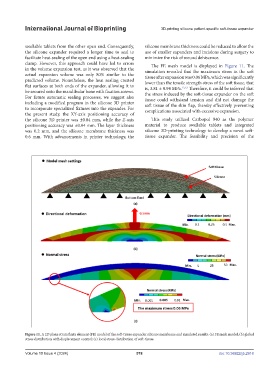
            clamp. However, this approach could have led to errors   The FE mesh model is displayed in  Figure 11. The
            in the volume expansion test, as it was observed that the   simulation revealed that the maximum stress in the soft
            actual expansion volume was only 80% similar to the   tissue after expansion was 0.06 MPa, which was significantly
            predicted volume. Nonetheless, the heat  sealing created   lower than the tensile strength stress of the soft tissue, that
            flat surfaces at both ends of the expander, allowing it to   is, 3.81 ± 0.94 MPa. 12,13  Therefore, it could be inferred that
            be secured onto the mandibular bone with fixation screws.   the stress induced by the soft-tissue expander on the soft
            For future automatic sealing processes, we suggest also   tissue could withstand tension and did not damage the
            including a modified program in the silicone 3D printer   soft tissue of the skin flap, thereby effectively preventing
            to incorporate specialized fixtures into the expander. For   complications associated with excessive expansion.
            the present study, the XY-axis positioning accuracy of
            the silicone 3D printer was ±0.04 mm, while the  Z-axis   This study utilized Carbopol 940 as the polymer
            positioning accuracy was ±0.04 mm. The layer thickness   material to produce swellable tablets and integrated
            was  0.2 mm,  and  the  silicone membrane  thickness  was   silicone 3D-printing technology to develop a novel soft-
            0.6 mm. With advancements in printer technology, the   tissue expander. The feasibility and precision of the


            Figure 11. A 2D plane strain finite element (FE) model of the soft-tissue expander silicone membrane and simulated results: (a) FE mesh model; (b) global
            stress distribution with displacement control; (c) local stress distribution of soft-tissue.


            Volume 10 Issue 4 (2024)                       578                                doi: 10.36922/ijb.2918

