


Page 184 - IJB-9-4
P. 184
International Journal of Bioprinting                                      3D-printed middle ear prostheses


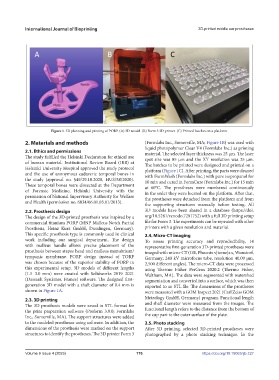
                       Figure 1. 3D planning and printing of PORP. (A) 3D model. (B) Form 3 3D printer. (C) Printed batches on a platform.

            2. Materials and methods                           (Formlabs Inc., Somerville, MA; Figure 1B) was used with
                                                               liquid photopolymer Clear V4 (Formlabs Inc.) as printing
            2.1. Ethics and permissions                        material. The selected layer thickness was 25 µm. The laser
            The study fulfilled the Helsinki Declaration for ethical use   spot size was 85 µm and the XY resolution was 25 µm.
            of human material. Institutional Review Board (IRB) at   The batches to be printed were designed and printed on a
            Helsinki University Hospital approved the study protocol   platform (Figure 1C). After printing, the parts were cleaned
            and the use of anonymous cadaveric temporal bones in   with FormWash (Formlabs Inc.) with pure isopropanol for
            the study (approval no. §49/29.10.2020, HUS/58/2020).   10 min and cured in FormCure (Formlabs Inc.) for 15 min
            These temporal bones were dissected at the Department   at 60°C. The prostheses were numbered continuously
            of Forensic Medicine, Helsinki University with the   in the order they were located on the platform. After that,
            permission of National Supervisory Authority for Welfare   the prostheses were detached from the platform and from
            and Health (permission no. 6834/06.01.03.01/2013).  the  supporting  structures manually before  testing. All
            2.2. Prosthesis design                             3D models have been shared in a database (https://doi.
            The design of the 3D-printed prosthesis was inspired by a   org/10.5281/zenodo.7281752) with a full 3D printing setup
            commercial titanium PORP (MNP Malleus Notch Partial   file for Form 3. The experiments can be repeated with other
            Prosthesis,  Heinz  Kurz  GmbH,  Dusslingen,  Germany).   printers with a given resolution and material.
            This specific prosthesis type is commonly used in clinical   2.4. Micro-CT imaging
            work including our surgical department. The design   To assess printing accuracy and reproducibility, 14
            with malleus handle allows precise placement of the   representative first-generation 3D-printed prostheses were
            prosthesis between stapes head and malleus manubrium/  imaged with micro-CT (GE, Phoenix v|tome|x s, Wunstorf,
            tympanic membrane. PORP design instead of TORP     Germany; 240 kV microfocus tube, resolution 40.09 μm,
            was chosen because of the superior stability of PORP in   2,500 different angles). The micro-CT data were processed
            this experimental setup. 3D models of different lengths   using Thermo Fisher PerGeos 2020.2 (Thermo Fisher,
            (1.5–3.0 mm) were created with Solidworks 2019–2021   Waltham, MA). The data were segmented with watershed
            (Dassault Systèmes, France) software. The designed first-  segmentation and converted into a surface, which was then
            generation 3D model with a shaft diameter of 0.4 mm is   exported to an STL file. The dimensions of the prostheses
            shown in Figure 1A.                                were measured with a GOM Inspect 2021 (Carl Zeiss GOM

            2.3. 3D printing                                   Metrology GmbH, Germany) program. Functional length
            The 3D prosthesis models were saved in STL format for   and shaft diameter were measured from the images. The
            the print preparation software (Preform 3.9.0; Formlabs   functional length refers to the distance from the bottom of
            Inc., Somerville, MA). The support structures were added   the cup part to the outer surface of the plate.
            to the modeled prostheses using software. In addition, the   2.5. Photo stacking
            dimensions of the prosthesis were marked on the support   After 3D printing, selected 3D-printed prostheses were
            structures to identify the prostheses. The 3D printer Form 3   photographed by a photo stacking technique. In the


            Volume 9 Issue 4 (2023)                        176                         https://doi.org/10.18063/ijb.727

