


Page 11 - IJB-9-6
P. 11
International Journal of Bioprinting                                             Electrospinning PETG


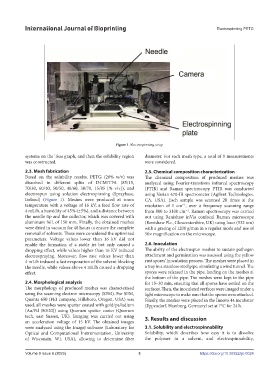
                                                  Figure 1. Electrospinning setup

            systems on the Teas graph, and then the solubility region   diameter. For each mesh type, a total of 9 measurements
            was constructed.                                   were considered.

            2.3. Mesh fabrication                              2.5. Chemical composition characterization
            Based on the solubility results, PETG (20% w/v) was   The chemical composition of produced meshes was
            dissolved in different splits of DCM/TFA (85/15,   analyzed using Fourier-transform infrared spectroscopy
            70/30, 60/40, 50/50, 40/60, 30/70, 15/85 [% v/v]), and   (FTIR)  and  Raman spectroscopy.  FTIR  was  conducted
            electrospun using solution electrospinning (Spraybase,   using Varian 670-IR spectrometer (Agilent Technologies,
            Ireland) (Figure  1). Meshes were produced at room   CA, USA). Each sample was scanned 20 times at the
            temperature with a voltage of 16 kV, a feed flow rate of   resolution of 1 cm , over a frequency scanning range
                                                                               -1
            4 mL/h, a humidity of 45% (±5%), and a distance between   from 800 to 3100 cm . Raman spectroscopy was carried
                                                                                -1
            the needle tip and the collector, which was covered with   out using Renishaw inVia confocal Raman microscope
            aluminum foil, of 150 mm. Finally, the obtained meshes   (Renishaw Plc., Gloucestershire, UK) using laser (532 nm)
            were dried in vacuum for 48 hours to ensure the complete   with a grating of 1200 g/mm in a regular mode and use of
            removal of solvents. These were considered the optimized   50× magnification on the microscope.
            parameters.  Voltage  values  lower  than  16  kV  did not
            enable  the  formation  of  a  stable  jet  but  only  caused  a   2.6. Inoculation
            dropping effect, while values higher than 16 KV induced   The ability of the electrospun meshes to sustain pathogen
            electrospraying. Moreover, flow rate values lower than   attachment and germination was assessed using the yellow
            4 mL/h induced a fast evaporation of the solvent blocking   rust spores’ inoculation process. The meshes were placed in
            the needle, while values above 4 mL/h caused a dropping   a tray in a stainless-steel pipe, simulating a wind tunnel. The
            effect.                                            spores were released in the pipe, landing on the meshes at
                                                               the bottom of the pipe. The meshes were kept in the pipe
            2.4. Morphological analysis                        for 15–30 min, ensuring that all spores have settled on the
            The morphology of produced meshes was characterized   surfaces. Then, the inoculated surfaces were imaged under a
            using the scanning electron microscopy (SEM). For SEM,   light microscope to make sure that the spores were attached.
            Quanta 650 (FEI company, Hillsboro, Oregon, USA) was   Finally, the meshes were placed in the Innova 44 incubator
            used, all meshes were sputter coated with gold/palladium   (Eppendorf, Hamburg, Germany) set at 7°C for 24 h.
            (Au/Pd (80/20)) using Quorum sputter coater (Quorum
            tech, east Sussex, UK). Imaging was carried out using   3. Results and discussion
            an acceleration voltage of 15 kV. The obtained images
            were analyzed using the ImageJ software (Laboratory for   3.1. Solubility and electrospinnability
            Optical and Computational Instrumentation, University   Solubility, which describes how easy it is to dissolve
            of Wisconsin, WI, USA), allowing to determine fiber   the polymer in a solvent, and electrospinnability,


            Volume 9 Issue 6 (2023)                         3                          https://doi.org/10.36922/ijb.0024

