


Page 108 - IJPS-7-2
P. 108
International Journal of
            Population Studies                                     Knowledge, attitudes, practices, and COVID-19 in Lebanon


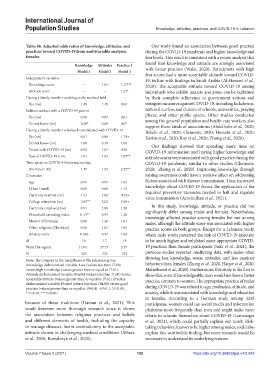
            Table 4b. Adjusted odds ratios of knowledge, attitudes, and   Our study found an association between good practice
            practices toward COVID‑19 from multivariable analyses,   during the COVID-19 pandemic and higher knowledge and
            females                                            fear levels. This result is consistent with a recent analysis that

                                 Knowledge  Attitudes  Practice 1  found that knowledge and attitude are strongly associated
                                  Model 1  Model 2  Model 3    with better practice (Wake, 2020). Participants with high
                                                               fear scores had a more acceptable attitude toward COVID-
            Independent variables                              19, in line with findings in Saudi Arabia (Al-Hanawi et al.,
             Knowledge score        --      1.04      1.17***  2020). The acceptable attitude toward COVID-19 among
             Attitude score         --       --     1.24*      individuals who exhibit anxiety and panic can be explained
            Having a family member working in the medical field  by their complete adherence to government actions and
             Yes (no)              1.49     1.49        0.84   stringent measures against COVID-19, including lockdowns,
            Indirect contact with a COVID-19 patient           national curfew, and closure of schools, universities, praying
             Yes (no)              0.96     0.87        0.61   places, and other public spaces. Other studies conducted
             Do not know (no)        0.36*  0.69        0.67   among the general population and health care workers also
                                                               support these kinds of associations (Abdelhafiz et al., 2020;
            Having a family member who has been infected with COVID-19
                                                               Bekele  et al.,  2020;  Clements, 2020; Hossain  et al.,  2020;
             Yes (no)              0.61     0.88     1.79+     Karim et al., 2020; Roy et al., 2020; Zhong et al., 2020).
             Do not know (no)      1.00     0.49        1.06     Our findings showed that spending more time on
             Tested with COVID-19 (no)  0.92  1.04        0.58  COVID-19 information and having higher knowledge and
             Fear of COVID-19 score  1.01   1.03        1.09**  attitude scores were associated with good practice during the
            Time spent on COVID-19 information/day             COVID-19 pandemic, similar to other studies (Clements,
             30+min (< 30)         1.17     1.53      2.25**   2020;  Zhong et al., 2020). Improving knowledge through
            Covariates                                         raising awareness could have a positive effect on addressing
             Age                   0.97     0.97        1.03   factors associated with disease transmission. Thus, increased
             Urban (rural)         0.66     0.66        1.15   knowledge about COVID-19 favors the application of the
             Currently married (no)  1.53   1.02     0.52+     required preventive measures needed to halt and regulate
                                                               virus transmission (Aravindhan et al., 2021).
             College education (no)      3.87**  2.02   2.60+
             Currently employed (no)  0.91  1.08        1.20     In this study, knowledge, attitude, or practice did not
             Household crowding index     0.44**  0.94        1.26  significantly differ among males and females. Nevertheless,
                                                               knowledge affected practice among females but not among
             Muslim (Christian)    0.60     1.36        1.04   males, although the attitude score was associated with higher
             Other religions (Christian)  0.56  1.04        1.05  practice scores in both groups. Except for a Lebanese study,
             Anxiety score           0.88+  0.94        1.08   where male youth perceived the risk of COVID-19 infection
            df                      16       17      18        to be much higher and exhibited more appropriate COVID-
            Wald Chi-square           11.04       27.73        3.57  19 practices than female participants (Sakr et al., 2021), the
            N                       323     323      323       previous studies reported conflicting data, with males often
                                                               showing less knowledge, worse attitudes, and less cautious
            Note: The category in the parentheses is the reference group.
            Knowledge dichotomized variable: Low (values less than 17.00)   behaviors than females (Zhong et al., 2020, Haque et al., 2020,
            versus high knowledge (values greater than or equal to 17.01).   Maheshwari et al., 2020). Furthermore, this study is the first to
            Attitude dichotomized variable: Fearful (values less than 17.00) versus   show that, even if knowledgeable, men would not have a better
            acceptable attitude (values greater than or equal to 17.01). Practice   practice, contrary to women. The appropriate practice of males
            dichotomized variable: Flawed (values less than 104.00) versus good
            practice (values greater than or equal to 104.01). +P<0.1, *P<0.05,   during COVID-19 was related to age, profession, attitude, and
            **P<0.01, ***P<0.001                               anxiety, while it was associated with knowledge and education
                                                               in females. According to a German study among 3245
            because of these traditions (Hassan  et  al., 2021). This   participants, women could use social media and information
            result deserves more thorough research since it shows   platforms more frequently than men and might make more
            the association between religious practices and beliefs   efforts to educate themselves about COVID-19 (Lemenager
            and different elements of health, including the capacity   et al., 2021), which could partially explain our result. Risk-
            to manage diseases, but is contradictory to the acceptable   taking behaviors, known to be higher among males, could also
            attitude shown in challenging medical conditions (Albers   explain this worthwhile finding, but more research would be
            et al., 2010, Kowalczyk et al., 2020).             necessary to understand its underlying reasons.


            Volume 7 Issue 2 (2021)                        102                     https://doi.org/10.36922/ijps.v7i2.342

