


Page 49 - IMO-2-1
P. 49
Innovative Medicines & Omics                              Current approach in the management of kidney disease


            induced phosphorylation of SMAD2/3 in human kidney-2   investigations are necessary to demonstrate whether
            (HK-2) cells. By modifying TGF-β1/SMADd3 and STAT3   fisetin’s beneficial and senolytic properties can be
            signaling, fisetin helps to improve kidney fibrosis. 56,57    translated into human use. According to a recent cohort
            Fisetin also reduces the release of inflammatory cytokines,   study sub-analysis, serum levels of senescence-associated
            AGEs, ROS, and NLR family pyrin domain containing 3   secretory phenotype factors, MMP-3 and MMP-9, platelet-
            (NLRP3) inflammasome – factors associated with diabetic   derived  growth  factor  AA,  IL-6  and  IL-8,  monocyte
            nephropathy. When the NLRP3 inflammasome is activated   chemoattractant  protein-1  (MCP-1), and  growth
            in mice, podocyte proteins such as nephrin and podocin   differentiation factor 11 and 15, dropped between baseline
            are lost, accompanied by mitochondrial dysfunction.   and follow-up visit in healthy individuals who self-dosed
                                                                                    59
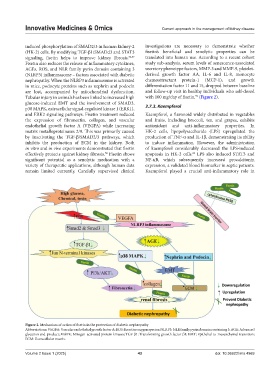
            Tubular injury in animals has been linked to increased high   with 100 mg/day of fisetin.  (Figure 2).
            glucose-induced EMT and the involvement of SMAD3,
            p38 MAPK, extracellular signal-regulated kinase 1 (ERK1),   3.7.3. Kaempferol
            and ERK2 signaling pathways. Fisetin treatment reduced   Kaempferol, a flavonoid widely distributed in vegetables
            the expression of fibronectin, collagen, and vascular   and fruits, including broccoli, tea, and grapes, exhibits
            endothelial growth factor A (VEGFA) while increasing   antioxidant and anti-inflammatory properties. In
            matrix metalloproteinases 2/9. This was primarily caused   HK-2  cells, lipopolysaccharide (LPS) upregulated the
            by inactivating the TGF-β/SMAD2/3 pathways, which   production of TNF-α and IL-1β, demonstrating its ability
            inhibits the production of ECM in the kidney. Both   to induce inflammation. However, the administration
            in vitro and in vivo experiments demonstrated that fisetin   of  kaempferol  considerably  decreased  the  LPS-induced
                                                                                   60
                                              58
            effectively protects against kidney fibrosis.  Fisetin shows   apoptosis in HK-2  cells.  LPS also induced STAT3 and
            significant  potential  as  a  senolytic  medication  with  a   NF-κB, which subsequently increased procalcitonin
            variety of therapeutic applications, although human data   expression, a validated blood biomarker in septic patients.
            remain limited currently. Carefully supervised clinical   Kaempferol  played  a crucial  anti-inflammatory role  in


            Figure 2. Mechanism of action of fisetin in the protection of diabetic nephropathy
            Abbreviations: VEGFA: Vascular endothelial growth factor A; ROS: Reactive oxygen species; NLRP3: NLR family pyrin domain containing 3; AGE: Advanced
            glycation end-product; MAPK: Mitogen-activated protein kinases; TGF-β1: Transforming growth factor-β1; EMT: Epithelial-to-mesenchymal transition;
            ECM: Extracellular matrix.


            Volume 2 Issue 1 (2025)                         43                               doi: 10.36922/imo.4969

