


Page 57 - IMO-2-1
P. 57
Innovative Medicines & Omics                               A perspective on medicinal cannabis delivery systems


              Cannabinoids are the most abundant and exclusive   anti-inflammatory, antineoplastic, and analgesic activities,
            metabolites of these species and the most important   whereas some lignanamides have shown cytotoxic activity. 3
            because they are capable of interacting with an entire
            system of endogenous receptors (endogenous cannabinoid   2. Medicinal cannabis delivery systems
            system). In addition, they are terpenophenolic in nature   Given the low bioavailability of cannabinoids, their clinical
            and are generally concentrated in the resin produced in the   use is limited. In this sense, the pharmaceutical industry is
            plant’s trichomes, especially in the female inflorescences.   focused on improving this point to optimize the different
            There are around 70 known terpenophenolics, of which   formulations. At present, a wide variety of cannabis
            tetrahydrocannabinol (THC) is the most studied.    products are commercially available to be administered in
                                                          3
            Cannabinoids are synthesized and accumulated as    several routes, namely oral, transdermal, pulmonary, and
            cannabinoid acids, and it is not until the drying and   transmucosal administration. Various release systems have
            storage process that the acids are gradually decarboxylated   been proposed for each administration route to increase
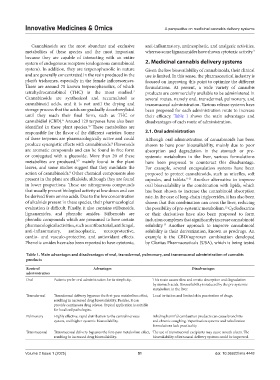
            until  they  reach  their  final  form,  such  as  THC  or   their efficacy.  Table  1 shows the main advantages and
            cannabidiol (CBD).  Around 120 terpenes have also been   disadvantages of each route of administration.
                            6
            identified in these plant species. These metabolites are
                                       3,7
            responsible for the flavor of the different varieties. Some   2.1. Oral administration
            of these terpenes are pharmacologically active and could   Although oral administration of cannabinoids has been
            produce synergistic effects with cannabinoids.  Flavonoids   shown to have poor bioavailability, mainly due to poor
                                                8
            are aromatic compounds and can be found in free form   absorption and degradation in the stomach or pre-
            or conjugated with a glucoside. More than 20 of these   systemic metabolism in the liver, various formulations
            metabolites are produced,  mainly found in the plant   have  been  proposed  to  counteract  this  disadvantage.
                                 3,7
            leaves, and some studies suggest that they modulate the   For example, several encapsulation systems  have been
            action of cannabinoids.  Other chemical components also   proposed  to  protect  cannabinoids,  such  as  micelles,  soft
                               8
            present in the plant are alkaloids, although they are found   capsules, and tablets. 9-11  Another alternative to improve
            in lower proportions. These are nitrogenous compounds   oral bioavailability is the combination with lipids, which
            that usually present biological activity at low doses and can   has been shown to increase the cannabinoid absorption
            be derived from amino acids. Due to the low concentration   rate. In the case of long-chain triglycerides, it has also been
            of alkaloids present in these species, their pharmacological   shown that this combination can cross the liver, reducing
            evaluation is difficult. Finally, it also contains stilbenoids,   the possibility of pre-systemic metabolism.  Cyclodextrins
                                                                                                 12
            lignanamides, and phenolic amides. Stilbenoids are   or their derivatives have also been proposed to form
            phenolic compounds which are presumed to have certain   inclusion complexes that significantly increase cannabinoid
            pharmacological activities, such as antibacterial, antifungal,   solubility.  Another approach to improve cannabinoid
                                                                       13
            anti-inflammatory,  antineoplastic,  neuroprotective,  solubility is their derivatization, known as prodrugs. An
            cardio-  and vasculo-protective, and antioxidant effects.   example is the CBD/naproxen combination developed
            Phenolic amides have also been reported to have cytotoxic,   by Claritas Pharmaceuticals (USA), which is being tested

            Table 1. Main advantages and disadvantages of oral, transdermal, pulmonary, and transmucosal administration of cannabis
            products

            Route of                     Advantages                                Disadvantages
            administration
            Oral        Patients prefer oral administration for its simplicity.  This route causes slow and erratic absorption and degradation
                                                                  by stomach acids. Bioavailability is reduced by the pre-systemic
                                                                  metabolism in the liver.
            Transdermal  Transdermal delivery bypasses the first-pass metabolism effect,  Local irritation and limited skin penetration of drugs.
                        resulting in increased drug bioavailability. Besides, it can
                        provide continuous drug release. Topical application is suitable
                        for localized pathologies.
            Pulmonary   Highly effective, rapid distribution to the central nervous   Inhaling harmful combustion products can cause bronchitis
                        system, and higher systemic bioavailability.  and chronic coughing. Vaporization systems and nebulization
                                                                  formulations lack practicality.
            Transmucosal  Transmucosal delivery bypasses the first-pass metabolism effect,  The use of transmucosal excipients may cause mouth ulcers. The
                        resulting in increased drug bioavailability.  bioavailability of intranasal delivery systems could be improved.


            Volume 2 Issue 1 (2025)                         51                               doi: 10.36922/imo.4448

