


Page 9 - ITPS-6-2
P. 9
INNOSC Theranostics and
            Pharmacological Sciences                                                     Theranostics in neurosurgery


            inhibited by tumor cells . Utilizing the patient’s own
                                [18]
            immune  system  against  the  tumor  prevents  many  side
            effects that other foreign agents could cause. FUS-directed
            chemotherapy has drastically improved clinical outcomes
            for patients with glioblastoma [16,17] . Many studies have
            observed increased inflammation and cranial edema after
            repeated FUS use, but this finding is dependent on the
            parameters of FUS used. For instance, one study by Choi
            et al. evaluating an animal model found that 0.25 MPa
            of pressure led to no cellular or tissue damage, whereas a
                                                        [19]
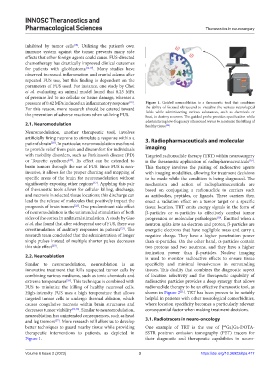
            pressure of 0.42 MPa induced an inflammatory response .   Figure  1. Guided neuroablation is a theranostic tool that combines
            For this reason, more research should be catered toward   the ability of focused ultrasound to visualize the various neurological
                                                               fields while administering various substances, such as chemicals or
            the prevention of adverse reactions when utilizing FUS.  heat, to destroy neurons. The guided probe provides specification while
                                                               administering low-frequency ultrasound waves to minimize the killing of
            2.1. Neuromodulation                               healthy tissue .
                                                                        [28]
            Neuromodulation, another  therapeutic tool,  involves
            artificially firing neurons to stimulate a response within a   3. Radiopharmaceuticals and molecular
            patient’s brain . In particular, neuromodulation was found
                       [20]
            to provide relief from pain and discomfort for individuals   imaging
            with mobility disorders, such as Parkinson’s disease (PD)   Targeted radionuclide therapy (TRT) within neurosurgery
            or Tourette syndrome . Its effect can be extended to   is the theranostic application of radiopharmaceuticals .
                              [21]
                                                                                                           [29]
            brain tumors through the use of FUS. Since FUS is non-  This therapy involves the pairing of radioactive agents
            invasive, it allows for the proper charting and mapping of   with imaging modalities, allowing for treatment decisions
            specific  areas of the brain for neuromodulation without   to be made while the condition is being diagnosed. The
                                         [22]
            significantly exposing other regions . Applying this pair   mechanism  and  action  of  radiopharmaceuticals  are
            of theranostic tools allows for cellular killing, discharge,   based on conjugating a radionuclide to carriers such
            and necrosis in selected tissue locations; this discharge can   as antibodies, peptides, or ligands. These carriers then
            lead to the release of molecules that positively impact the   enact a radiation effect on a tumor target or a specific
            prognosis of brain tumors . One predominant side effect   tissue location. TRT emits energy signals in the form of
                                 [22]
            of neuromodulation is the unintended stimulation of both   β-particles or  α-particles to effectively combat tumor
            sides of the cortex in unilateral stimulation. A study by Guo   progression or molecular pathologies . Emitted when a
                                                                                             [30]
            et al. also found that after widespread use of FUS, there was   neutron splits into an electron and proton, β-particles are
            overstimulation of auditory responses in patients . The   energetic electrons that have negligible mass and carry a
                                                    [23]
            research team concluded that the administration of longer   negative charge. They have a higher penetration power
            single pulses instead of multiple shorter pulses decreases   than α-particles. On the other hand, α-particles contain
            this side effect .                                 two protons and two neutrons, and they have a higher
                       [23]
                                                               ionization  power  than  β-particles.  Nuclear  imaging
            2.2. Neuroablation                                 is  used  to monitor  radioactive effects  to ensure tissue
            Similar to neuromodulation, neuroablation is an    specificity  and  minimal  invasiveness  in  surrounding
            innovative treatment that kills suspected tumor cells by   tissues. This duality that combines the diagnostic aspect
            combining various mediums, such as toxic chemicals and   of location selectivity and the therapeutic capability of
            extreme temperatures . This technique is combined with   radioactive particles provides a deep synergy that allows
                             [24]
            FUS to minimize the killing of healthy neuronal cells.   radionuclide therapy to be an effective theranostic tool, as
            High-intensity  FUS  uses  a  high  temperature  that  allows   shown in Figure 2 . TRT has been proven to be notably
                                                                              [31]
            targeted tumor cells to undergo thermal ablation, which   helpful in patients with other neurological comorbidities,
            causes coagulative necrosis within brain structures and   where location specificity becomes a particularly relevant
            decreases tumor viability [25,26] . Similar to neuromodulation,   consequential factor when making treatment decisions.
            neuroablation has unintended consequences, such as head
            and leg tremors . More research will allow us to develop   3.1. Radiotracers in neuro-oncology
                        [27]
            better techniques to guard nearby tissue while providing   One example of TRT is the use of [ Ga]Ga-DOTA-
                                                                                                68
            therapeutic interventions to patients, as depicted in   SSTR positron emission tomography (PET) tracers for
            Figure 1.                                          their  diagnostic and therapeutic capabilities  in neuro-


            Volume 6 Issue 2 (2023)                         3                         https://doi.org/10.36922/itps.417

