


Page 110 - ITPS-7-1
P. 110
INNOSC Theranostics and
            Pharmacological Sciences                                              Anti-ulcer activity of Rheum spiciforme


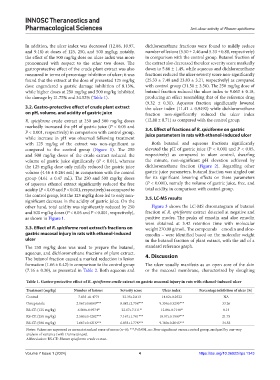
            In addition, the ulcer index was decreased (12.88, 10.97,   dichloromethane fractions  were found  to mildly reduce
            and 9.18) at doses of 125, 250, and 500 mg/kg; notably,   number of lesions (5.50 ± 2.46 and 5.33 ± 0.88, respectively)
            the effect of the 500 mg/kg dose on ulcer index was more   in comparison with the control group. Butanol fraction of
            pronounced  with  respect  to the  other  two  doses.  The   the extract also decreased the ulcer severity score markedly
            gastroprotective effect of the crude plant extract was also   down to 5.66 ± 1.49, while aqueous and dichloromethane
            measured in terms of percentage inhibition of ulcer; it was   fractions reduced the ulcer severity score non-significantly
            found that the extract at the dose of presented 125 mg/kg   (25.33 ± 7.49 and 23.83 ± 3.21, respectively) as compared
            dose engendered a gastric damage inhibition of 8.13%,   with control group (31.50 ± 3.56). The 250 mg/kg dose of
            while higher doses at 250 mg/kg and 500 mg/kg inhibited   butanol fraction reduced the ulcer index to 9.063 ± 0.18,
            the damage by 21.75% and 34.52% (Table 1).         producing an effect resembling that of the reference drug
                                                               (9.32 ± 0.31). Aqueous fraction significantly lowered
            3.2. Gastro-protective effect of crude plant extract   the ulcer index (11.41 ± 0.9492) while dichloromethane
            on pH, volume, and acidity of gastric juice        fraction non-significantly reduced the ulcer index
            R. spiciforme  crude extract at 250 and 500  mg/kg doses   (12.88 ± 0.71) as compared with the control group.
            markedly increased the pH of gastric juice (P < 0.05 and   3.4. Effect of fractions of R. spiciforme on gastric
            P < 0.001, respectively) in comparison with control group,   juice parameters in rats with ethanol-induced ulcer
            while increase in pH was observed following treatment
            with 125  mg/kg of the extract was non-significant as   Both butanol and aqueous fractions significantly
            compared to the control group (Figure  1). The 250   elevated the pH of gastric juice (P < 0.001 and P < 0.05,
            and 500  mg/kg doses of the crude extract reduced the   respectively) as compared to ulcer control, dwarfing
            volume of gastric juice significantly (P  < 0.01), whereas   the minute, non-significant pH elevation achieved by
            the 125 mg/kg dose only mildly reduced the gastric juice   dichloromethane fraction (Figure  2). Regarding other
            volume (4.46 ± 0.264 mL) in comparison with the control   gastric juice parameters, butanol fraction was singled out
            group (4.61 ± 0.47  mL). The 250 and 500  mg/kg doses   for  its  significant  lowering  effects  on  these  parameters
            of aqueous ethanol extract significantly reduced the free   (P < 0.001), namely the volume of gastric juice, free, and
            acidity (P < 0.05 and P < 0.001, respectively) as compared to   total acidity, in comparison with control group.
            the control group, but the 125 mg/kg dose led to only non-
            significant decrease in the acidity of gastric juice. On the   3.5. LC-MS results
            other hand, total acidity was significantly reduced by 250   Figure 3 shows the LC-MS chromatogram of butanol
            and 500 mg/kg doses (P < 0.05 and P < 0.001, respectively),   fraction of R. spiciforme extract detected at negative and
            as shown in Figure 1.                              positive modes. The peaks of emodin and aloe emodin
                                                               were obtained at 3.42 retention time with molecular
            3.3. Effect of R. spiciforme root extract’s fractions on   weight 270.00 g/moL. The compounds – emodin and aloe-
            gastric mucosal injury in rats with ethanol-induced   emodin – were identified based on the molecular weight
            ulcer                                              in the butanol fraction of plant extract, with the aid of a
            The 250  mg/kg dose was used to prepare the butanol,   standard reference graph.
            aqueous, and dichloromethane fractions of plant extract.
            The butanol fraction caused a marked reduction in lesion   4. Discussion
            formation (1.66 ± 0.42) in comparison to the control group   The ulcer usually manifests as an open sore of the skin
            (7.16 ± 0.30), as presented in Table 2. Both aqueous and   or the mucosal membrane, characterized by sloughing

            Table 1. Gastro-protective effect of R. spiciforme crude extract on gastric mucosal injury in rats with ethanol-induced ulcer
            Treatment (mg/kg)   Number of lesions   Severity score    Ulcer index     Percentage inhibition of ulcer (%)
            Control               7.833 ±0.4773      32.33±2.813      14.02±0.2522              NA
            Omeprazole            2.167±0.6009***   8.083±2.758***   9.356±0.3295***            33.26
            RS-CE (125 mg/kg)     6.500±0.9574 ns    22.67±7.311 ns  12.88±0.7148 ns            8.13
            RS-CE (250 mg/kg)     2.500±0.4282***   7.167±1.701***   10.97±0.1909***            21.75
            RS-CE (500 mg/kg)     1.667±0.4216***   6.833±1.778***   9.180±0.2045***            34.52
            Notes: Values are expressed as means±standard error of mean (n=6); ***P<0.001, ns: Non-significant versus control group, analyzed by one-way
            analysis of variance (with Dunnett’s test).
            Abbreviation: RS-CE: Rheum spiciforme crude extract.


            Volume 7 Issue 1 (2024)                         4                         https://doi.org/10.36922/itps.1343

