


Page 89 - ITPS-8-1
P. 89
INNOSC Theranostics and
            Pharmacological Sciences                                        Brain glutamate level after treatment with NAC


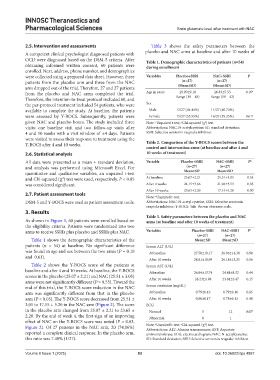
            2.5. Intervention and assessments                    Table 3 shows the safety parameters between the

            A competent clinical psychologist diagnosed patients with   placebo and NAC arms at baseline and after 10 weeks of
            OCD were diagnosed based on the DSM-5 criteria. After   Table 1. Demographic characteristics of patients (n=54)
            obtaining informed written consent, 60  patients were   during enrollment
            enrolled. Next, address, phone number, and demographics
            were collected using a prepared data sheet. However, three   Variables  Placebo+SSRI  NAC+SSRI  P
            patients from the placebo arm and three from the NAC              (n=27)         (n=27)
            arm dropped out of the trial. Therefore, 27 and 27 patients      (Mean±SD)      (Mean±SD)
            from the placebo and NAC arms completed the trial.   Age in years  29.00±9.18   26.83±5.53    0.10 x
            Therefore, the intention-to-treat protocol included 60, and     Range (18 – 48)  Range (18 – 42)
            the per-protocol treatment included 54 patients, who were   Sex
            available to complete the study. At baseline, the patients   Male  12/27 (44.44%)  11/27 (40.74%)
            were assessed by Y-BOCS. Subsequently, patients were   Female   15/27 (55.55%)  16/27 (59.25%)  0.61 y
            given NAC and placebo boxes. The study included three   Note:  Unpaired t-test;  Chi-squared (χ ) test
                                                                              y
                                                                   x
                                                                                        2
            visits: one baseline visit and two follow-up visits after   Abbreviations: NAC, N-acetylcysteine; SD, standard deviation;
            4 and 10 weeks with a visit window of ±4 days. Patients   SSRI: Selective serotonin reuptake inhibitor.
            were visited to assess their response to treatment using the
            Y-BOCS after 4 and 10 weeks.                       Table 2. Comparison of the Y‑BOCS scores between the
                                                               control and intervention arms (at baseline and after 4 and
            2.6. Statistical analysis                          10 weeks of treatment)
            All data were presented as a mean ± standard deviation,   Variable   Placebo+SSRI  NAC+SSRI    P x
            and analysis was performed using Microsoft Excel. For               (n=27)        (n=27)
            quantitative and qualitative variables, an unpaired t-test         Mean±SD       Mean±SD
            and Chi-squared (χ ) test were used, respectively. P < 0.05   At baseline  25.07±2.21  25.51±3.05  0.55
                            2
            was considered significant.                        After 4 weeks   24.15±3.66    21.96±3.53   0.03
                                                               After 10 weeks  23.65±2.20    17.15±5.20   0.00
            2.7. Patient assessment tools
                                                               Note:  Unpaired t-test.
                                                                   x
            DSM-5 and Y-BOCS were used as patient assessment tools.  Abbreviations: NAC: N-acetyl cysteine; SSRI: Selective serotonin
                                                               reuptake inhibitor; Y-BOCS: Yale–Brown obsessive scale.
            3. Results
                                                               Table 3. Safety parameters between the placebo and NAC
            As shown in Figure 1, 60 patients were enrolled based on   arms (at baseline and after 10 weeks of treatment)
            the eligibility criteria. Patients were randomized into two
            arms to receive SSRIs plus placebo and SSRIs plus NAC.  Variables      Placebo+SSRI  NAC+SSRI  P x
                                                                                     (n=27)      (n=27)
              Table 1 shows the demographic characteristics of the                  Mean±SD     Mean±SD
            patients (n = 54) at baseline. No significant difference   Serum ALT (U/L)
            was found in age and sex between the two arms (P = 0.10   At baseline   27.50±18.17  26.96±14.38  0.90
            and  0.61).
                                                                After 10 weeks      28.81±18.99  26.18±13.25  0.56
              Table 2 shows the Y-BOCS score of the patients at   Serum AST (U/L)
            baseline and after 4 and 10 weeks. At baseline, the Y-BOCS   Atbaseline  26.84±13.74  24.41±8.32  0.44
            scores in the placebo (25.07 ± 2.21) and NAC (25.51 ± 3.05)
            arms were not significantly different (P = 0.55). Toward the   After 10 weeks  28.23±1.98  23.81±6.47  0.15
            end of this trial, the Y-BOCS score reduction in the NAC   Serum creatinine (mg/dL)
            arm was significantly different from that in the placebo   At baseline  0.79±0.19   0.79±0.16  0.85
            arm (P < 0.05). The Y-BOCS score decreased from 25.51 ±   After 10 weeks  0.80±0.17  0.78±0.13  0.48
            3.05 to 17.15 ± 5.20 in the NAC arm (Figure 2). The score   ECG
            in the placebo arm changed from 25.07 ± 2.21 to 23.65 ±   Normal           5          12      0.07 z
            2.20. By the end of week 4, the first sign of an improving   Abnormal      0           1
            effect of NAC on the Y-BOCS score was noted (P = 0.03,   x        z         2
            Figure  2). Of 27  patients in the NAC arm, 20  (74.06%)   Note:  Unpaired t-test;  Chi-squared (χ ) test.
                                                               Abbreviations: ALT: Alanine transaminase; AST: Aspartate
            reported a complete clinical response. In the placebo arm,   aminotransferase; ECG: electrocardiogram; NAC: N-acetylcysteine;
            this ratio was 7.40% (1/27).                       SD: Standard deviation; SSRI: Selective serotonin reuptake inhibitor.


            Volume 8 Issue 1 (2025)                         83                               doi: 10.36922/itps.4887

