


Page 12 - JCAU-4-1
P. 12
Pingyao Historic City and Qiao Family Courtyard                                                                                     Zhang


               once  controlled  over  50  percent  of  the   their original shapes, with mainly 17th‒19th
               country’s  financial  institutions  in  the  Ming   century buildings on both sides, maintaining
               and Qing dynasties, its status was comparable   their  traditional  layouts  and  styles.  The
               to the “Wall Street” in the USA today. The     mostly 2-storey shops have colorful paintings
               West  Avenue  starts  from  the  west  to      under the eaves and vibrant carvings on the
               Xiaximen  (fengyimen),  intersecting  at  the   beams.  The  vernacular  houses  all  have
               north  end  of  South  Avenue  in  the  east,   courtyards  with  grey  bricks  and  tiles,  with
               forming  a  straight  through  access  with  the   clear  axes  and  symmetrical  plans.  Pingyao
               East Avenue, known as the “First Financial     Historic  City  has  completely  preserved  its
               Street of the Qing Dynasty.” The East Avenue   Ming and Qing appearance for three reasons.
               begins from the east at the Lower East Gate    Firstly,  Pingyao  had  experienced  less  wars
               (qinhanmen), intersecting at the north end of   when Shanxi was ruled by Yan Xishan (阎锡
               the  South  Avenue  in  the  west,  forming  a   山,  1883‒1960)  from  1911.  Japan  invaded
               straight access through the West Avenue. The   China in 1937 and made damages to Pingyao.
               North  Avenue  commences  from  the  North     During the Chinese Civil War (1945‒1949),
               Gate (gongjimen) in the north, connecting to   the  Nationalist  Army  abandoned  the  city
               the  middle  part  of  the  West  Avenue  in  the   before  fleeing  to  Taiwan  in  1949,  Pingyao
               south  [4-6]  [Figure 5].                      was  then  returned  to  the  people.  Secondly,

                                                              Pingyao is situated in a dry land that generally
                                                              has less groundwater, as such, it has not been
                                                              run over by modern industrial development.
                                                              Thirdly,  for  many  years,  Pingyao  local
                                                              government  had  financial  difficulties  to
                                                              renovate the Old City. After the reform and
                                                              opening-up  in  1978,  the  State  Council
                                                              announced  in  1986  that  Pingyao  was  a
                                                              national historic and cultural city, and it was
                                                              listed  as  a  World  Heritage  Site  in  1997,
                                                              making  Pingyao  Historic  City  a  fully
                                                              protected  status,  which  has  become  a  huge
                                                              resource for tourism development and a pillar
                                                              industry for its local economy  [1, 4] .
                                                                   From  the  “Master  Plan  of  Pingyao
                                                              County” (Pingyao Xiancheng Zongti Guihua)
                                                              3  compiled  and  edited  by  Pingyao  County
                                                              Government in 1980, to the ongoing revision
                                                              of “Regulations on the Protection of Pingyao
                                                              Historic  City  in  Shanxi  Province”  (Shanxi
                                                                                                         4
                                                              Sheng  Pingyao  Gucheng  Baohu  Tiaoli),
                                                              Pingyao has always adhered to the practice of
                                                              overall protection of its historic features, not
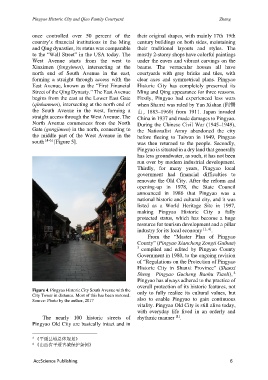
               Figure 4. Pingyao Historic City South Avenue with the
               City Tower in distance. Most of this has been restored.   only  to  fully  realize  its  cultural  values,  but
               Source: Photo by the author, 2017              also  to  enable  Pingyao  to  gain  continuous
                                                              vitality. Pingyao Old City is still alive today,
                                                              with  everyday  life  lived  in  an  orderly  and
                                                                               [1]
                    The  nearly  100  historic  streets  of   rhythmic manner  .
               Pingyao Old City are basically intact and in

               3  《平遥县城总体规划》
               4  《山西省平遥古城保护条例》


                AccScience Publishing                                                                  6

