


Page 14 - JCAU-4-1
P. 14
Pingyao Historic City and Qiao Family Courtyard                                                                                     Zhang


                    In  the  3rd  year  of  Daoguang  ( 道  光  )   dynasty was not on the coast or in the capital
               (1823),  a  time-honored  dyeing  shop  “Xi    of Beijing, it was in Taigu, Qi County, and
               Yucheng”  ( 西   裕  成  )  on  Pingyao’s  West   Pingyao in the inland of Shanxi, and Pingyao
               Avenue  was  replaced  with  the  signboard    was the best”  [1, 2, 4] .
               “Rishengchang”  (日   升  昌  ),  which  literally
               means “Rising Sun with Prosperity” [Figure
               12]. Rishengchang was China’s first currency
               exchange  shop  or  remittance  bank,  called
               piaohao,    that   accepted   the   bearers’
               certificates  from  one  city/place,  to  be
                                                      5
               redeemed for cash in another city/place.  The
               piaohao  system  ended  the  escort  ushering
               cash  in  the  past,  making  long-distance
               remittances safer, and had greatly accelerated
               business operations  [5, 9] . The famous writer,
               Yu Qiuyu (余秋雨), regarded Rishengchang
               as the “Grandfather” of China’s commercial
               industry; it was indeed a milestone of China’s
               economic  development.  In  the  1840s,
               Rishengchang      successively   established
               branches in over 30 cities across China, and at
               the  end  of  the  Qing  dynasty  (1911)  even
               reached  Mongolia,  Russia,  Korea,  Japan,
               India, Singapore, Europe, America, and other
               parts  of  the  world.  It  had  created  a  unique
               Chinese    financial   management     model
               through  strict  self-discipline,  forming  a
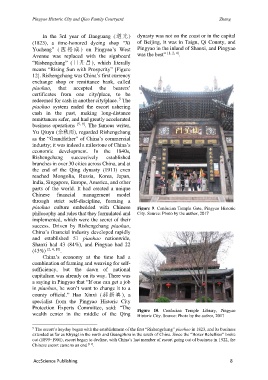
               piaohao  culture  embedded  with  Chinese      Figure 9. Confucian Temple Gate, Pingyao Historic
               philosophy and rules that they formulated and   City. Source: Photo by the author, 2017
               implemented, which were the secret of their
               success.  Driven  by  Rishengchang  piaohao,
               China’s financial industry developed rapidly
               and  established  51  piaohao  nationwide,
               Shanxi  had  43  (84%),  and  Pingyao  had  22
               (43%)  [2, 4, 10] .
                    China’s  economy  at  the  time  had  a
               combination of farming and weaving for self-
               sufficiency,  but  the  dawn  of  national
               capitalism was already on its way. There was
               a saying in Pingyao that “If one can get a job
               in piaohao, he won’t want to change it to a
               county  official.”  Hao  Xinxi  ( 郝  新  喜  ),  a
               specialist  from  the  Pingyao  Historic  City
               Protection  Experts  Committee,  said:  “The     Figure  10.  Confucian  Temple  Library,  Pingyao
               wealth  center  in  the  middle  of  the  Qing   Historic City. Source: Photo by the author, 2017


               5  The escort’s heyday began with the establishment of the first “Rishengchang” piaohao in 1823, and its business
               extended as far as Khyagt in the north and Guangzhou in the south of China. Since the “Boxer Rebellion” broke
               out (1899‒1901), escort began to decline, with China’s last member of escort going out of business in 1922, the
               Chinese escort came to an end  [11] .


                AccScience Publishing                                                                  8

