


Page 51 - JCAU-5-1
P. 51
Journal of Chinese
            Architecture and Urbanism                               Microbial technologies: Toward a regenerative architecture


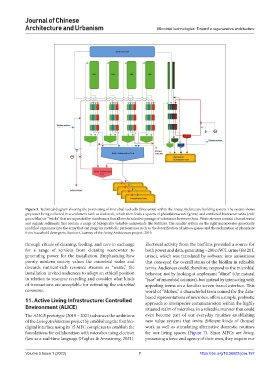
            Figure 5. Technical diagram showing the positioning of microbial fuel cells (blue units) within the Living Architecture building system. The system shows
            greywater being collected in a settlement tank as feedstock, which then feeds a system of photobioreactors (green) and combined bioreactor units (red/
            green/blue) or “bricks” that are separated by membranes that allow the selective passage of substances between them. Waste streams contain cleaned water
            and organic sediments that contain a range of biologically valuable compounds like fertilizer. The smaller system on the right incorporates genetically
            modified organisms into the array that can program metabolic performance such as the detoxification of nitrous gasses and the reclamation of phosphate
            from household detergents. Source: Courtesy of the Living Architecture project, 2019.

            through rituals of cleaning, feeding, and care in exchange   Electrical activity from the biofilms provided a source for
            for a range of services from cleaning wastewater to   both power and data, generating ~200 mW/L urine (for 20 L
            generating power for  the installation.  Emphasizing  how   urine), which was translated by software into animations
            poorly  modern  society  values  the  microbial  realm  and   that conveyed the overall status of the biofilm in relatable
            discards nutrient-rich resource streams as “waste,” the   terms. Audiences could, therefore, respond to the microbial
            installation invited audiences to adopt an ethical position   behavior, not by looking at unpleasant “slime” (the natural
            in relation to resource recycling and consider what kinds   “face” of microbial colonies), but instead by interacting with
            of transactions are acceptable for activating the microbial   appealing forms on a familiar screen-based interface. This
            commons.                                           world of “Mobes,” a characterful term coined for the data-
                                                               based representations of microbes, offers a simple, probiotic
            11. Active Living Infrastructure: Controlled       approach to interspecies communication within the highly
            Environment (ALICE)                                situated realm of microbes, in a relatable manner that could
            The ALICE prototype (2019 – 2021) advances the ambitions   even become part of our everyday routines establishing
            of the Living Architecture project by establishing the first bio-  new value systems that invite different kinds of (house)
            digital interface using its 15 MFC complexes to establish the   work as well as stimulating alternative domestic routines
            foundations for collaboration with microbes using electron   for our living spaces (Figure  7). Since MFCs are  living,
            flow as a real-time language (Hughes & Armstrong, 2021).   possessing a force and agency of their own, they require our


            Volume 5 Issue 1 (2023)                         7                         https://doi.org/10.36922/jcau.157

