


Page 107 - JCAU-6-1
P. 107
Journal of Chinese
            Architecture and Urbanism                                          Cultural tourism integration in Yubai Village


            later developed as a whole and renamed Silt White Village   There are some tourism resources within Yubai Village,
            and was also known as Yubai Village. The whole village has   and the tertiary industry is expected to grow. However, at
            a strong history, and the pattern of streets and courtyards   present, the only thing that can be used for the development of
            in the village has basically maintained its historical style.   cultural tourism in the village is the Baipu Temple on the north
            Historic houses, old wells, stone mills, old black trees, and   side, the Goddess Temple, and the field complex. In general,
            so on can be seen everywhere in the village, and several old   the local tourism resources are scarce, and the characteristics
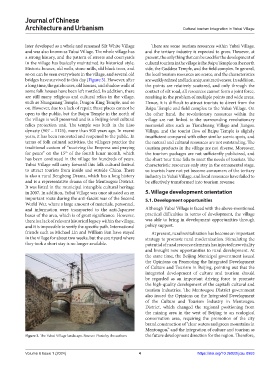
            bridges have survived to this day (Figure 3). However, after   are weakly refined and lack unique attractiveness. In addition,
            a long time, the gatehouses, old houses, and shadow walls of   the points are relatively scattered, and only through the
            some folk houses have been left mottled. In addition, there   contact of silt road, all resources cannot form a joint force,
            are still many religious and cultural relics in the village,   resulting in the problem of multiple points and wide areas.
            such as Niangniang Temple, Dragon King Temple, and so   Hence, it is difficult to attract tourists to divert from the
            on. However, due to a lack of repair, these places cannot be   Baipu Temple and field complex to the Yubai Village. On
            open to the public, but the Baipu Temple in the north of   the other hand, the revolutionary resources within the
            the village is well preserved and is a Beijing-level cultural   village are not linked to the surrounding revolutionary
            relics  protection  unit.  The  temple  was  built  in  the  Liao   memorial sites such as Tianzhuang Village and Jiangou
            dynasty (907 – 1125), more than 900 years ago. In recent   Village, and the tourist flow of Baipu Temple is slightly
            years, it has been renovated and reopened to the public. In   insufficient compared with other similar scenic spots, and
            terms of folk cultural activities, the villagers practice the   the natural and cultural resources are not outstanding. The
            traditional custom of “receiving the Empress and praying   tourism products in the village are not diverse. Moreover,
            for peace” on the 15  of the fourth lunar month, which   the tourism packages are not sufficiently publicized, and
                             th
            has been continued in the village for hundreds of years.   the short tour time fails to meet the needs of tourists. The
            Yubai Village will carry forward this folk cultural festival   characteristic resources only stay in the ornamental stage,
            to attract tourists from inside and outside China. There   so tourists have not yet become consumers of the tertiary
            is also a rural Bengbeng Drama, which has a long history   industry in Yubai Village, and local resources have failed to
            and is a representative drama of the Mentougou District.   be effectively transformed into tourism revenue.
            It was listed in the municipal intangible cultural heritage
            in 2007. In addition, Yubai Village was once situated on an   5. Village development orientation
            important route during the anti-fascist war of the Second   5.1. Development opportunities
            World War, where a large amount of materials, personnel,
            and information were transported to the anti-Japanese   Although Yubai Village is faced with the above-mentioned
            bases of the area, which is of great significance. However,   practical difficulties in terms of development, the village
            there is a lack of relevant historical legacy within the village,   was able to bring in development opportunities through
            and it is impossible to verify the specific path. International   policy support.
            friends such as Michael Lin and William Ban have stayed   At present, rural revitalization has become an important
            in the village for about two weeks, but the courtyard where   strategy to promote rural modernization. Stimulating the
            they took a short stay is no longer available.     potential of rural resource elements has injected new vitality
                                                               and brought new opportunities to rural development. At
                                                               the same time, the Beijing Municipal government issued
                                                               the Opinions on Promoting the Integrated Development
                                                               of Culture and Tourism in Beijing, pointing out that the
                                                               integrated development of culture and tourism should
                                                               be regarded as an important driving force to promote
                                                               the high-quality development of the capital’s cultural and
                                                               tourism industries. The Mentougou District government
                                                               also issued the Opinions on the Integrated Development
                                                               of the Culture and Tourism Industry in Mentougou
                                                               District, which changed the regional positioning from
                                                               the mining area in the west of Beijing to an ecological
                                                               conservation area, requiring the promotion of the city
                                                               brand construction of “clear waters and green mountains in
                                                               Mentougou,” and the integration of culture and tourism as
            Figure 3. The Yubai Village landscape. Source: Photo by the authors  the future development direction for the region. Therefore,


            Volume 6 Issue 1 (2024)                         4                        https://doi.org/10.36922/jcau.0953

