


Page 46 - JCAU-6-1
P. 46
Journal of Chinese
            Architecture and Urbanism                                         A study on the spatial characteristics of gara


            also solidified their political influence (Luengo, 2023); (iii)   the fundamental reasons for changes in urban structure
            Prosperous Colonial Period: Western colonizers exerted   and residential types at both the macro-urban and micro-
            their influence on military, economic, religious, and social   architectural levels (Eddy et al., 2020).
            aspects of the colony, prompting distinct planning for
            various ethnic and religious groups; (iv) Modern Period:   2. Shophouse, haveli, and gara
            In the modern era, some traditional cities have vanished,   Traditional Indian houses are commonly referred to
            whereas others have flourished into major metropolises   as the courtyard-style  haveli (Figure  2). However, the
            (Wang & Jia, 2016). From the ancient “Maritime Silk Road,”   field investigation conducted in this study showed that
            to European colonization and national independence, the   the traditional houses in Surat are not havelis, and their
            forms and architectural typologies of Asian port cities   planning features closely resemble those of the shophouses
            have predominantly been shaped by three factors: trade,   in the Malay Peninsula and Indochina Peninsula (Figure 3).
            colonization, and religion.
              India, situated along the route of the “Maritime Silk   2.1. Haveli
            Road,” harbors Surat, a city in Gujarat, as a port city   Haveli is a noble residence in North India, characterized
            that emerged within this dynamic environment. The   by similar width and depth, representing a courtyard-style
            city  was  founded by Akbar,  the third emperor of  the   architecture. In general, it features two courtyards, with
            Mughal dynasty, establishing the first seaport city. After   the front yard intended for men’s use and the backyard
            the  16   century,  Surat  became  a  stronghold  for  Muslim   for women’s use. Courtyards are generally square shaped
                 th
            merchants engaging in maritime trade across the Indian   and mainly used for natural light and ventilation purposes.
            Ocean (Gupta, 1979). Spanning from the late 16  century   Depending on the needs, haveli can be divided into family
                                                   th
            to the first half of the 18  century, Surat served as a trading   rooms, reception rooms, trade office rooms, and carriage
                               th
            hub of Asia for the Portuguese, British, and Dutch. Due   garages (Bera, 2020).
            to its unique geographical location, Gujarat directly
            links to ports along the west coast of India, the Arabian   2.2. Form, origin, and development of shophouse
            Sea, the Persian Gulf, the Red Sea, and the east coast of   The involvement of Western colonizers in Asian trade
            Africa. In addition, it serves as a hub for trade routes to   competition promoted architectural innovation (Luengo,
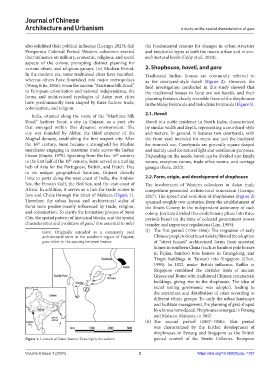
            Java and China through the Strait of Malacca (Figure 1).   2017). The spread and evolution of shophouses (Figure 2)
            Therefore, the urban layout and architectural styles of   spanned roughly two centuries, from the establishment of
            Surat  were  predominantly  influenced  by  trade,  religion,   the Straits Colony to the independent autonomy of each
            and colonization. To clarify the formation process of Surat   colony. Jon Lim divided this evolutionary phase into three
            City, the spatial pattern of historical blocks, and the spatial   periods based on the time of colonial government power
            characteristics and evolution of gara,  it is essential to infer   transfer and important regulations (Lim, 1993):
                                         1
            1        Gara: Originally intended as a commonly used   (i)  The first period (1786–1866): The migration of early
                   architectural term in the southern region of Gujarat,   Chinese people to Southeast Asia facilitated the adoption
                   gara refers to the spacing between beams.      of “street houses” architectural forms from ancestral
                                                                  homes in southern China (such as bamboo pole houses
                                                                  in Fujian, bamboo tube houses in Guangdong, and
                                                                  Tingzi buildings in Taiwan) into Singapore (Chen,
                                                                  1998). In 1822, under British influence, Raffles in
                                                                  Singapore combined the corridor form of ancient
                                                                  Greece and Rome with traditional Chinese commercial
                                                                  buildings, giving rise to the shophouse. The idea of
                                                                  racial zoning governance was adopted, leading to
                                                                  the separation and distribution of cities according to
                                                                  different ethnic groups. To unify the urban landscape
                                                                  and facilitate management, the planning of grid-shaped
                                                                  blocks was introduced. Shophouses emerged in Penang
                                                                  and Malacca, Malaysia, in 1862.
                                                               (ii)  The second period (1867–1926): This period
                                                                  was characterized by the further development of
                                                                  shophouses in Penang and Singapore as the British
            Figure 1. Location of Surat. Source: Drawing by the authors  gained control of the Straits Colonies. European


            Volume 6 Issue 1 (2024)                         2                        https://doi.org/10.36922/jcau.1797

