


Page 38 - JCAU-6-2
P. 38
Journal of Chinese
            Architecture and Urbanism                                          Regenerating tradition: Rural revitalization


            Village residents. The people of Yulong Village maintain   However, the dominant trend in modern agricultural
            their worship and reverence for the mountains, forests,   development, primarily focused on quantitative growth,
            rivers, and land. In front of every house, there is a small   has largely eroded the beliefs and traditional farming
            shrine where the Li family make offerings to mountain   practices  of  the  Li  family.  With  the  damming  of  the
            god, earthly god, and other deities. Shanlan rice is still   Changhua  River,  uncontrolled  development  of  land
            venerated; at the borders of some uncultivated mountains   resources, modernized agriculture emphasizing cash
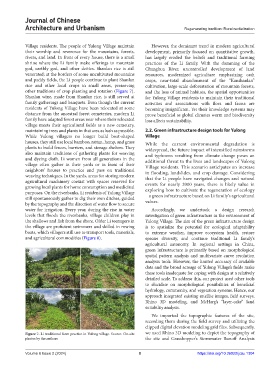
            and paddy fields, the Li people continue to plant Shanlan   crops, near-total abandonment of the “Kanshanlan”
            rice and other local crops in small areas, preserving   cultivation, large-scale deforestation of mountain forests,
            other traditions of crop planting and rotation (Figure 7).   and the loss of animal habitats, the spatial opportunities
            Shanlan wine, made from Shanlan rice, is still served at   for Yulong Village residents to maintain their traditional
            family gatherings and banquets. Even though the current   activities and associations with flora and fauna are
            residents of Yulong Village have been relocated at some   becoming insignificant. Yet their knowledge systems may
            distance from the ancestral forest cemeteries, modern Li   prove beneficial as global climates warm and biodiversity
            family have adapted forest areas near where their relocated   loss affects sustainability.
            village meets their agricultural fields as a new cemetery,
            maintaining trees and plants in that area as lush as possible.   2.2. Green infrastructure design tools for Yulong
            While Yulong villagers no longer build boat-shaped   Village
            houses, they still use local bamboo, rattan, hemp, and grass   While  the  current  environmental  degradation  is
            plants to build fences, barriers, and storage shelters. They   widespread, the future impact of intensified rainstorms
            also maintain traditions of gathering plants for weaving   and  typhoons  resulting  from  climate  change  poses  an
            and dyeing cloth. Li women from all generations in the   additional threat to the lives and landscapes of Yulong
            village often gather in their yards or in front of their   Village residents. This scenario anticipates an increase
            neighbors’ houses to practice and pass on traditional   in flooding, landslides, and crop damage. Considering
            weaving techniques. In the yards, areas for storing modern   that the Li people have navigated changes and natural
            agricultural machinery coexist with spaces reserved for   events for nearly 2000  years, there is likely value in
            growing local plants for home consumption and medicinal   exploring how to cultivate the regeneration of ecology
            purposes. On the riverbanks, Li residents of Yulong Village   – a green infrastructure based on Li family’s agricultural
            still spontaneously gather to dig their own ditches, guided
            by the topography and the direction of water flow to secure   values.
            water for irrigation. Every year, during the rise in water   Accordingly, we undertook a design research
            levels that floods the riverbanks, village children play in   investigation of green infrastructure in the environment of
            the shallows and fish from the shore. Older Li teenagers in   Yulong Village. The aim of the green infrastructure design
            the village are proficient swimmers and skilled in rowing   is to spatialize the potential for ecological adaptability
            boats, which villagers still use to transport tools, materials,   to extreme weather, improve ecosystem health, restore
            and agricultural commodities (Figure 8).           species diversity, and continue traditional Li family’s
                                                               agricultural autonomy. In regional settings in China,
                                                               green infrastructure is primarily based on morphological
                                                               spatial pattern analysis and multivariate curve resolution
                                                               analysis tools. However, the limited accuracy of available
                                                               data and the broad acreage of Yulong Village’s fields make
                                                               these tools inadequate for coping with design at a relatively
                                                               detailed scale. To address this, our project used other tools
                                                               to elucidate on morphological possibilities of beneficial
                                                               hydrology, community, and vegetation systems. Hence, our
                                                               approach integrated existing satellite images, field surveys,
                                                               Rhino  3D modeling, and McHarg’s “layer-cake” land
                                                               suitability analysis.
                                                                 We  imported  the  topographic  features  of  the  site,
                                                               recording them during the field survey and utilizing the
                                                               clipped digital elevation modeling grid files. Subsequently,
            Figure 7. Li traditional farm practice in Yulong village. Source: On-site   we used Rhino 3D modeling to depict the topography of
            photos by the authors                              the site and Grasshopper’s Stormwater Runoff Analysis


            Volume 6 Issue 2 (2024)                         8                        https://doi.org/10.36922/jcau.1304

