


Page 39 - JCAU-7-3
P. 39
Journal of Chinese
            Architecture and Urbanism                                                       Top-down rural heritage


            1. Introduction

            Dongguan, a significant industrial center within the
            Pearl River Delta economic zone of Guangdong, China,
            has experienced rapid  urbanization and a  gradual
            transformation of its rural villages since the establishment
            of the Shenzhen Special Economic Zone. In 2006, Tangwei
            village (塘尾村), along with the adjacent Nanshe village
            (南社村), was designated as a Major Cultural Heritage
            Site  under National-level  Protection (全国重点文物保
            护单位) by the State Council of the People’s Republic of
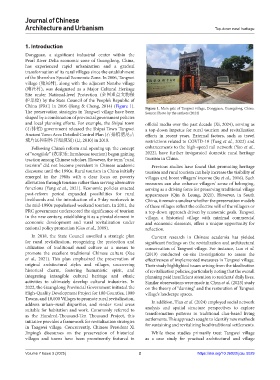
            China (PRC) in 2006 (Jiang & Cheng, 2014) (Figure 1).   Figure 1. Main gate of Tangwei village, Dongguan, Guangdong, China.
            The preservation strategies in Tangwei village have been   Source: Photo by the authors (2024)
            shaped by a combination of provincial government policies
            and local planning efforts. For example, the Shipai town   official media over the past decade (Xi, 2024), serving as
            (石排镇) government released the Shipai Town Tangwei   a top-down impetus for rural tourism and revitalization
            Ancient Town Area Detailed Control Plan (石排镇塘尾古    efforts in recent years. External factors, such as travel
            城片区控制性详细规划) (Li, 2010) in 2010.                    restrictions related to COVID-19 (Tang et al., 2022) and
              Following China’s reform and opening up, the concept   enhancements to the high-speed rail network (Yao et al.,
            of “nongjiale” (农家乐; farmhouse tourism) began gaining   2022), have further invigorated domestic rural heritage
            traction among Chinese scholars. However, the term “rural   tourism in China.
            tourism” did not become prevalent in Chinese academic   Previous studies have found that promoting heritage
            discourse until the 1990s. Rural tourism in China initially   tourism and rural tourism can help increase the visibility of
            emerged in the 1980s  with a clear focus on poverty   villages and boost villagers’ income (Su et al., 2016). Such
            alleviation through tourism rather than serving alternative   measures can also enhance villagers’ sense of belonging,
            functions (Yang et al., 2021). Economic policies enacted   serving as a driving force for preserving traditional village
            post-reform period expanded possibilities for rural   appearances (Qin & Leung, 2021). However, in South
            livelihoods and the introduction of a 5-day workweek in   China, it remains unclear whether the preservation models
            the mid-1990s popularized weekend tourism. In 2001, the   of these villages reflect the collective will of the villagers or
            PRC government underscored the significance of tourism   a top-down approach driven by economic goals. Tangwei
            in the new century, establishing it as a pivotal element in   village, a historical village with minimal commercial
            economic development and rural revitalization under   and economic elements, offers a unique opportunity for
            national policy promotion (Gao et al., 2009).      reflection.
              In 2018, the State Council unveiled a strategic plan   Current research in Chinese academia has yielded
            for rural revitalization, recognizing the protection and   significant findings on the revitalization and architectural
            utilization of traditional rural culture as a means to   conservation of Tangwei village. For instance, Luo et al.
            promote the excellent traditional Chinese culture (Xue   (2019) conducted on-site investigations to assess the
            et al., 2021). This plan emphasized the preservation of   effectiveness of implemented measures in Tangwei village.
            original architectural styles and villages, uncovering   Their study highlighted issues arising from the idealization
            historical charm, fostering humanistic spirit, and   of revitalization policies, particularly noting that the overall
            integrating intangible cultural heritage and ethnic   planning paid insufficient attention to residents’ daily lives.
            activities to ultimately  develop  cultural  industries.  In   Similar observations were made in Chen et al. (2023) study
            2022, the Guangdong Provincial Government initiated the   on the theory of “darning” and the restoration of Tangwei
            High-Quality Development Project for 100 Counties, 1000   village’s landscape spaces.
            Towns, and 10,000 Villages to promote rural revitalization,
            address  urban–rural disparities,  and render  rural  areas   In addition, Tian et al. (2024) employed social network
            suitable for habitation and work. Commonly referred to   analysis and spatial structure perspectives to explore
            as the Hundred-Thousand-Ten Thousand Project, this   transformation  patterns  in  traditional  clan-based  living
            initiative provides a framework for revitalization strategies   settlements. This approach sought to identify new methods
            in Tangwei village. Concurrently, Chinese President Xi   for sustaining and revitalizing local traditional settlements.
            Jinping’s  discourses  on the preservation  of historical   While these studies primarily treat Tangwei village
            villages  and  towns  have  been  prominently  featured  in   as a case study for practical architectural and village


            Volume 7 Issue 3 (2025)                         2                        https://doi.org/10.36922/jcau.5029

