


Page 61 - JCBP-1-2
P. 61
Journal of Clinical and
            Basic Psychosomatics                                                   Somatization symptoms of outpatient


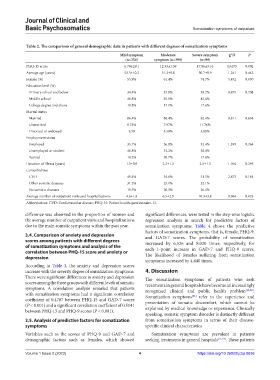
            Table 2. The comparison of general demographic data in patients with different degrees of somatization symptoms
                                                    Mild symptom     Moderate      Severe symptom   χ /F   P
                                                                                                   2
                                                      (n=254)      symptom (n=399)    (n=99)
            PHQ-15 score                              6.79±2.01      12.33±1.39      17.86±3.16   13.675  0.002
            Average age (years)                       53.5±10.2       51.2±9.8        50.7±9.9    1.241  0.442
            Female (%)                                 55.9%           61.4%          74.7%       5.492  0.030
            Education level (%)
             Primary school and below                  34.4%           37.8%          39.7%       0.875  0.708
             Middle school                             46.8%           45.0%          42.6%
             College degree and above                  18.8%           17.1%          17.6%
            Marital status
             Married                                   86.4%           88.4%          82.4%       0.811  0.634
             Unmarried                                 9.74%           7.97%          11.76%
             Divorced or widowed                        3.90           3.59%          5.88%
            Employment status
             Employed                                  35.1%           26.8%          32.4%       1.399  0.264
             Unemployed or student                     46.8%           52.2%          50.0%
             Retired                                   18.2%           20.7%          17.6%
            Duration of illness (years)                1.3±0.9        2.2±1.2         2.5±1.3     1.106  0.295
            Comorbidities
             CVD                                       49.4%           54.6%          51.5%       2.873  0.181
             Other somatic diseases                    31.2%           25.1%          22.1%
             No somatic diseases                       19.5%           20.3%          26.4%
            Average number of outpatient visits and hospitalizations   4.6±1.8  6.5±2.9  10.3±3.8  9.964  0.023
            Abbreviations: CVD: Cardiovascular disease; PHQ-15: Patient health questionnaire-15.

            difference was observed in the proportion of women and   significant differences, were tested in the step-wise logistic
            the average number of outpatient visits and hospitalizations   regression analysis in search for predictive factors of
            due to the main somatic symptoms within the past year.  somatization symptoms.  Table 4 shows the predictive
                                                               factors of somatization symptoms, that is, female, PHQ-9,
            3.4. Comparison of anxiety and depression          and GAD-7 scores. The probability of somatization
            scores among patients with different degrees       increased  by  6.526  and  8.020  times,  respectively,  for
            of somatization symptoms and analysis of the       each 1-point increase in GAD-7 and PHQ-9 scores.
            correlation between PHQ-15 score and anxiety or    The likelihood of females suffering from somatization
            depression
                                                               symptoms increased by 4.440 times.
            According to  Table 3, the anxiety and depression scores
            increase with the severity degree of somatization symptoms.   4. Discussion
            There were significant differences in anxiety and depression   The  somatization  symptoms  of  patients  who  seek
            scores among the three groups with different levels of somatic   treatments in general hospitals have become an increasingly
            symptoms. A  correlation analysis revealed that patients   recognized clinical and public health problem [19,20] .
            with somatization symptoms had a significant correlation   Somatization symptoms  refer to the experience and
                                                                                   [21]
            coefficient of 0.4787 between PHQ-15 and GAD-7 scores   presentation of somatic discomfort, which cannot be
            (P < 0.001) and a significant correlation coefficient of 0.5141
            between PHQ-15 and PHQ-9 scores (P < 0.001).       explained by medical knowledge or experience. Clinically
                                                               speaking, somatic symptom disorder is distinctly different
            3.5. Analysis of predictive factors for somatization   from somatization symptoms in terms of their disease-
            symptoms                                           specific clinical characteristics.
            Variables such as the scores of PHQ-9 and GAD-7 and   Somatization symptoms are prevalent in patients
            demographic factors such as females, which showed   seeking treatments in general hospitals [11,19] . These patients


            Volume 1 Issue 2 (2023)                         4                        https://doi.org/10.36922/jcbp.0636

