


Page 28 - JCBP-2-2
P. 28
Journal of Clinical and
            Basic Psychosomatics                               reported a slightly higher importance of hedonism or self-
                                                                            Life values in representative general population


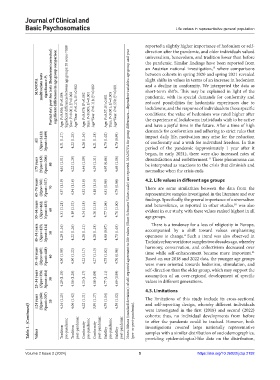
                       Partial eta 2 ; post-hoc tests (Bonferroni corrected)   the pandemic. Similar findings have been reported from
                                                        Notes: Means (standard deviation) of self-reported agreement to life values (Short Schwartz Values scale) are reported. MANOVA for group differences—dependent variables: age group and year
                                                               direction after the pandemic, and older individuals valued
                                                               universalism, benevolism, and tradition lower than before
                                                               an Austrian national investigation,  where comparisons
                                                                                           15
                                                               between cohorts in spring 2020 and spring 2021 revealed
                                                               slight shifts in values in terms of an increase in hedonism
                 MANOVA  multivariate tests  significance P; significant differences in age group comparison Significant differences between age groups: 20 versus 70,80  Age*Year: P=0.274; E 2 =0.002  Age*Year: P=0.118; E 2 =0.002  Age*Year: P=0.559; E 2 =0.001  short-term shifts. This may be explained in light of the
                                                               and a decline in conformity. We interpreted the data as
                                Year: P<0.001; E 2 =0.002
                                       Year: P<0.009; E 2 =0.001
                                                Year: P<0.001; E 2 =0.003
                                     Age: P=0.079; E 2 =0.002
                            Age: P=0.005; E 2 =0.004
                                                               pandemic,  with  its  special  demands  for  conformity  and
                                              Age: P=0.57; E 2 =0.001
                                                               reduced possibilities for  hedonistic  experiences due  to
                                                               lockdowns, and the response of individuals to these specific
                                                               conditions; the value of hedonism was rated higher after
                                                               the experience of lockdowns; individuals wish to be active
                                                               and have a joyful time in the future. After a time of high
                                                               demands for conformism and adhering to strict rules that
                   (Npre=2412;  Npost=2499)                    of conformity and a wish for individual freedom. In this
                 All        4.31 (1.17)  4.22 (1.25)  4.26 (1.16)  4.21 (1.18)  4.79 (1.02)  4.70 (0.99)  impact daily life, motivation may arise for the reduction
                                                               period of the pandemic (approximately 1  year after it
                                                               began, in early 2021), there were also increased rates of
                                                               dissatisfaction and embitterment.  These phenomena can
                                                                                          11
                 ≥75 years  (Npre=165;  Npost=206)  80  4.61 (1.01)  4.22 (1.20)  4.44 (1.09)  4.19 (1.31)  4.95 (0.86)  4.69 (1.00)  be interpreted as reactions to the crisis that diminish and
                                                               normalize when the crisis ends.
                 65–74 years  (Npre=307;  Npost=337)  70  4.37 (1.19)  4.34 (1.16)  4.32 (1.18)  4.18 (1.15)  4.81 (0.98)  4.79 (0.94)  4.2. Life values in different age groups
                                                               There are some similarities between the data from the
                                                               representative samples investigated in the literature and our
                                                               findings. Specifically, the general importance of universalism
                 55–64 years  (Npre=462;  Npost=483)  60  4.31 (1.21)  4.19 (1.32)  4.24 (1.18)  4.26 (1.18)  4.77 (1.04)  4.70 (1.00)  and benevolence, as reported in other studies,  was also
                                                                                                     18
                                                               evident in our study, with these values ranked highest in all
                                                               age groups.
                                                                 There is a tendency for a loss of religiosity in Europe,
                 45–54 years  (Npre=455;  Npost=414)  50  4.29 (1.16)  4.22 (1.26)  4.28 (1.11)  4.28 (1.18)  4.80 (0.97)  4.75 (1.03)  accompanied by a shift toward values emphasizing
                                                               openness to change.  Such a trend was also observed in
                                                                               4
                                                               Turkish urban workforce samples two decades ago, whereby
                 35–44 years   (Npre=407;  Npost=448)  40  4.30 (1.08)  4.30 (1.22)  4.22 (1.17)  4.27 (1.15)  4.75 (1.02)  4.70 (0.96)  harmony,  conservation,  and  collectivism  decreased  over
                                                               time while self-enhancement became more important.
                                                                                                            21
                                                               Based on our 2018 and 2022 data, the younger age groups
                                                               were more oriented towards hedonism, stimulation, and
                 25–34 years   (Npre=356;  Npost=404)  30  4.29 (1.18)  4.16 (1.28)  4.23 (1.17)  4.18 (1.09)  4.77 (1.11)  4.69 (0.99)  self-direction than the older group, which may support the
                                                               assumption of an over-regional development of specific
                                                               values in different generations.
                                                               4.3. Limitations
                 ≤24 years   (Npre=260;  Npost=207)  20  4.16 (1.25)  4.06 (1.42)  4.22 (1.21)  3.95 (1.27)  4.79 (1.04)  4.59 (1.02)  The limitations of this study include its cross-sectional
                                                               and self-reporting design, whereby different individuals
             Table 1. (Continued)  Values  Tradition   pre-pandemic  Tradition   post-pandemic  Conformity    pre-pandemic  Conformity    post-pandemic  Stability    pre-pandemic  Stability    post-pandemic  (pre- or post-pandemic).  cohorts; thus, no individual developments from before
                                                               were investigated in the first (2018) and second (2022)

                                                               to after the pandemic could be tracked. However, both
                                                               investigations covered large nationally representative
                                                               samples with a similar distribution of sociodemographics,


                                                                                     https://doi.org/10.36922/jcbp.2192
            Volume 2 Issue 2 (2024)                         5   providing epidemiological-like data on the distribution,

