


Page 66 - JCBP-2-3
P. 66
Journal of Clinical and
            Basic Psychosomatics                                           Depression among medical students and doctors


            survey did not include an additional patient-rated difficulty   Table 1. Demographics of medical students and doctors
            item.
                                                               Demographics             Medical students  Doctors
              As we proceeded with our discussion, evaluating the   Gender, n (%)
            prevalence of depression symptoms compared to data   Female                      63 (81.8)  54 (78.3)
            from other countries on doctors’ depression, we included a
            paragraph detailing studies that specifically used the PHQ-9   Male              13 (16.9)  13 (18.8)
            questionnaire to make comparisons more significant.  Non-binary                  1 (1.3)  1 (1.4)
                                                                Chose not to say             0 (0.0)  1 (1.4)
            2.3. Sociodemographic variables                    City size, n (%)
            The questionnaire included demographic data such as   Large city                 62 (80.5)  62 (89.9)
            gender, age, city size, and group. When selecting gender   Medium city           4 (5.2)  2 (2.9)
            in the questionnaire, options included female, male, non-  Small city            6 (7.8)  3 (4.3)
            binary, or choosing not to say. When comparing PHQ-9   Rural area                5 (6.5)  2 (2.8)
            scores between genders, we compared them between men   Median age, years (min – max)  21 (18 – 24)  29 (25 – 70)
            and women, as only two individuals chose non-binary, and
            one chose not to say. City size options included large cities   PHQ-9 (mean±SD)       10.49±5.89  8.46±5.52
            (>250,000 inhabitants), medium cities (50,000 – 250,000),   Abbreviations: PHQ-9: Patient Health Questionnaire-9; SD: Standard
            small cities (<50,000), and rural areas. The average PHQ   deviation.
            score was compared between individuals living in large
            cities and others (medium cities, small cities, and rural   medical students, and 22 (31.9%) were doctors. The mean
            areas). The group question allowed selections from medical   PHQ-9 score was 10.49 ± 5.89 for medical students and
            students, doctors, and others. In the introductory text,   8.46 ± 5.52 for doctors, revealing a statistically significant
            we noted that the definition of doctor includes resident   difference between the groups (mean rank: 80.12 vs. 66.11;
            doctors.                                           P = 0.045). For gender differences, the mean PHQ-9 was
                                                               9.78 ± 6.01 for women and 8.46 ± 4.60 for men. There
            2.4. Statistical analysis                          was no statistically significant difference between genders
                                                               (female mean rank = 73.29; male mean rank = 66.21;
            The statistical analyses were conducted using MS Excel and   P  = 0.430). Among medical students, the mean PHQ-9
            SPSS v29 software. Given the non-normal distribution of   score for women was 10.86 and for men was 8.69, with no
            the data, the Mann–Whitney U test was employed to assess   statistically significant difference found between genders
            differences in the PHQ-9 scores among the two groups.   (mean rank 39.98 vs. 31.35, P = 0.198). Similarly, among
            Statistical significance was defined as P <0.05.   doctors, the mean PHQ-9 score for women was 8.52

            3. Results                                         and for men was 8.23, with no statistically significant
                                                               difference observed (mean rank = 33.65  vs. 35.46;
            A  total  of  146  respondents  answered  the  questionnaire,   P = 0.762). Regarding residency, 124 individuals answered
            with 77 identifying as “medical students,” 69 as “doctors,”   that they live in large cities and 22 in other areas. No
            and  none selecting  “other.”  Among  the  respondents,   statistically significant difference was found in the PHQ-9
            117 (80.1%) were female, 26 (17.8%) were male, two (1.4%)   scores between people who live in large cities and those
            chose the non-binary option, and one (0.7%) preferred not   in other areas (mean rank = 73.91 vs. 71.18; P = 0.780).
            to disclose their gender. The median age of respondents   Correspondingly, no differences in PHQ-9 were found
            was 24 ± 8.26 (range: 18 – 70 years). Regarding residency,   when comparing medical students (P = 0.577) and doctors
            124 individuals reported living in a large city (more than   (P = 0.181) living in different locations. Table 2 presents
            250,000 inhabitants), six in a medium-sized city (50,000   the detailed data on PHQ-9 scores between groups.
            –  250,000  inhabitants),  nine  in  a small city (<50,000
            inhabitants), and seven in a rural area. The overall mean   4. Discussion
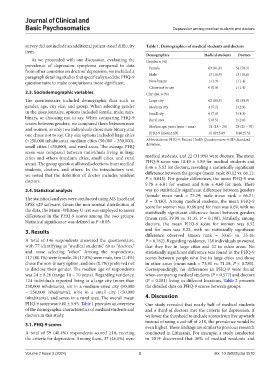
            PHQ-9 score was 9.60 ± 5.93. Table 1 provides an overview   Our study revealed that nearly half of medical students
            of the demographic characteristics of medical students and   and a third of doctors met the criteria for depression. If
            doctors in this study.                             we lower the threshold to include scores from five upwards
                                                               instead of using a cut-off of ≥10, the prevalence would be
            3.1. PHQ-9 scores
                                                               even higher. These findings are similar to previous research
            A total of 59  (40.4%) respondents scored ≥10, meeting   conducted in Lithuania. For example, a study conducted
            the criteria for depression. Among them, 37 (48.1%) were   in 2019 discovered that 36% of medical residents and


            Volume 2 Issue 3 (2024)                         3                               doi: 10.36922/jcbp.3570

