


Page 67 - JCBP-2-3
P. 67
Journal of Clinical and
            Basic Psychosomatics                                           Depression among medical students and doctors


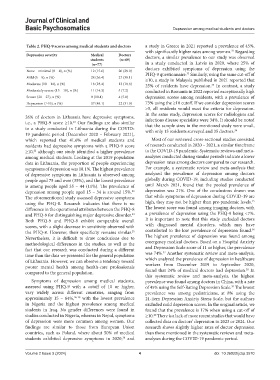
            Table 2. PHQ‑9 scores among medical students and doctors  a study in Greece in 2021 reported a prevalence of 45%,
                                                               with significantly higher rates among women.  Regarding
                                                                                                   31
            Depression severity         Medical    Doctors     doctors, a similar prevalence to our study was observed
                                        students    (n=69)
                                        (n=77)                 in  a  study  conducted  in  Latvia in  2020,  where  25%  of
            None – minimal (0 – 4), n (%)  12 (15.6)  20 (29.0)  doctors exhibited symptoms  of depression using the
                                                               PHQ-9 questionnaire.  Similarly, using the same cut-off of
                                                                                32
            Mild (5 – 9), n (%)         28 (36.4)  27 (39.1)
                                                               ≥10, a study in Malaysia published in 2021 reported that
            Moderate (10 – 14), n (%)   18 (23.4)  13 (18.8)   25% of residents have depression.  In contrast, a study
                                                                                           33
            Moderately severe (15 – 19), n (%)  11 (14.3)    5 (7.2)  conducted in Romania in 2022 reported exceptionally high
            Severe (20 – 27), n (%)       8 (10.4)    4 (5.8)  depression scores among residents, with a prevalence of
            Depression (≥10), n (%)     37 (48.1)  22 (31.9)   73% using the ≥10 cutoff. If we consider depression scores
                                                               >5, all residents would meet the criteria for depression.
                                                               In the same study, depression scores for radiologists and
            26%  of  doctors  in  Lithuania  have  depressive  symptoms,   infectious disease specialists were 34%. It should be noted
            i.e., a PHQ-9 score ≥10.  Our findings are also similar   that the sample sizes in the mentioned study were small,
                                21
            to a study conducted in Lithuania during the COVID-  with only 15 residents surveyed and 35 doctors. 34
            19 pandemic period (December 2020 – February 2021),
            which  reported  that  41.6%  of  medical  students  and   Most of our reviewed cross-sectional studies consisted
            residents had depressive symptoms with a PHQ-9 score   of research conducted in 2020 – 2021, a similar timeframe
               22
            ≥10,  although our study identified a higher prevalence   to the COVID-19 pandemic. Systematic reviews and meta-
            among medical students. Looking at the 2019 population   analyses conducted during similar periods indicate a lower
            data in Lithuania, the proportion of people experiencing   depression rates among doctors compared to our research.
            symptoms of depression was 18.1%. The highest prevalence   For example, a systematic review and meta-analysis that
            of depressive symptoms in Lithuania is observed among   analyzed the prevalence of depression among doctors
            people aged 75 and over (35%), and the lowest prevalence   globally during COVID-19, including studies conducted
            is among people aged 35 – 44 (11%). The prevalence of   until March 2021, found that the pooled prevalence of
            depression among people aged 15 – 34 is around 15%.    depression was 21%. One of the conclusions drawn was
                                                         23
            The aforementioned study assessed depressive symptoms   that while symptoms of depression during COVID-19 are
                                                                                                            35
            using the PHQ-8. Research indicates that there is no   high, they may not be higher than pre-pandemic levels.
            difference in the operational attributes between the PHQ-8   The lowest score was found among imaging doctors, with
            and PHQ-9 for distinguishing major depressive disorder.    a prevalence of depression using the PHQ-9 being <7%.
                                                         24
            Both PHQ-9 and PHQ-8 exhibit comparable overall    It is important to note that this study excluded doctors
            scores, with a slight decrease in sensitivity observed with   with  diagnosed mental disorders, which may  have
                                                                                                            36
            the PHQ-8. However, their specificity remains similar.    contributed to the low prevalence of depression found.
                                                         25
            Nevertheless,  it is  difficult to draw  conclusions  due  to   The highest prevalence of depression was found among
            methodological differences in the studies, as well as the   emergency medical doctors. Based on a Hospital Anxiety
            fact that our research was conducted during a different   and Depression Scale score of 11 or higher, the prevalence
                                                                      37
            time than the data we presented for the general population   was 74%.  Another systematic review and meta-analysis,
            of Lithuania. However, we can observe a tendency toward   which analyzed the prevalence of depression in healthcare
            poorer mental health among health-care professionals   workers from December 2019 to September 2020,
                                                                                                          38
            compared to the general population.                found that 24% of medical doctors had depression.  In
                                                               this systematic review and meta-analysis, the highest
              Symptoms of depression among medical students,   prevalence was found among doctors in China, with a rate
            assessed using PHQ-9 with a cutoff of 10 or higher,   of 45% using the Self-Rating Depression Scale.  The lowest
                                                                                                   39
            vary widely across different countries, ranging from   prevalence was among pediatricians, at 8% using the
            approximately 15 – 64%, 26-29  with the lowest prevalence   21-item Depression Anxiety Stress Scale, but the authors
            in Nigeria and the highest prevalence among medical   excluded mild depression scores. In the original article, we
            students in Iraq. No gender differences were found in   found that the prevalence is 17% when using a cut-off of
            studies conducted in Nigeria, whereas in Nepal, symptoms   ≥10.  There is a lack of more recent studies that would have
                                                                  40
            of depression were more common among women. Our    collected data on doctors’ depression in 2023 or 2024. Our
            findings are similar to those from European Union   research shows slightly higher rates of doctor depression
            countries, such as Poland, where about 50% of medical   than those mentioned in the systematic reviews and meta-
            students exhibited depressive symptoms in 2020,  and   analyses during the COVID-19 pandemic period.
                                                     30

            Volume 2 Issue 3 (2024)                         4                               doi: 10.36922/jcbp.3570

