


Page 78 - JCBP-2-3
P. 78
Journal of Clinical and
            Basic Psychosomatics                                                          HD-tDCS on pain in SSD-P


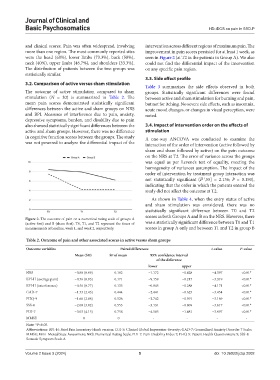
            and clinical scores. Pain was often widespread, involving   intervention across different regions of maximum pain. The
            more than one region. The most commonly reported sites   improvement in pain scores persisted for at least 1 week, as
            were the head (60%), lower limbs (73.3%), back (50%),   seen in Figure 2 (at T2 in the patients in Group A). We also
            neck (40%), upper limbs (46.7%), and shoulders (33.3%).   could not find the differential impact of the intervention
            The distribution of patients between the two groups was   on any specific pain region.
            statistically similar.
                                                               3.3. Side effect profile
            3.2. Comparison of active versus sham stimulation
                                                               Table 3 summarizes the side effects observed in both
            The outcome of active stimulation compared to sham   groups. Statistically significant differences were found
            stimulation (N  = 30) is summarized in  Table 2. The   between active and sham stimulation for burning and pain,
            mean pain scores demonstrated statistically significant   but not for itching. No severe side effects, such as insomnia,
            differences between the active and sham groups on NRS   acute mood changes, or changes in visual perception, were
            and BPI. Measures of interference due to pain, anxiety,   noted.
            depressive symptoms, burden, and disability due to pain
            also showed statistically significant differences between the   3.4. Impact of intervention order on the effects of
            active and sham groups. However, there was no difference   stimulation
            in cognitive function scores between the groups. The study   A one-way ANCOVA was conducted to examine the
            was not powered to analyze the differential impact of the   interaction of the order of intervention (active followed by
                                                               sham and sham followed by active) on the pain outcome
                                                               on the NRS at T2. The error of variance across the groups
                                                               was equal as per Levene’s test of equality, meeting the
                                                               homogeneity of variances assumption. The impact of the
                                                               order of intervention by treatment group interaction was
                                                               not statistically significant (F ,55] = 2.136;  P  = 0.150),
                                                                                       [1
                                                               indicating that the order in which the patients entered the
                                                               study did not affect the outcome at T2.
                                                                 As shown in Table 4, when the entry status of active
                                                               and sham stimulation was considered, there was no
                                                               statistically significant difference between T0 and T2
                                                               scores in both Groups A and B on the NRS. However, there
            Figure 2. The outcome of pain on a numerical rating scale of groups A
            (active first) and B (sham first). T0, T1, and T2 represent the times of   was a statistically significant difference between T0 and T1
            measurements at baseline, week 1, and week 2, respectively.  scores in group A only and between T1 and T2 in group B

            Table 2. Outcome of pain and other associated scores in active versus sham groups
            Outcome variables                       Paired differences                     t‑value     P‑value
                                 Mean (SD)      SE of mean       95% confidence interval
                                                                    of the difference
                                                                lower         upper
            NRS                  −0.80 (0.99)     0.182         −1.172        −0.428       −4.397       <0.01*
            BPI-H (average pain)  −0.56 (0.93)    0.171         −9.159        −0.217       −3.319       <0.01*
            BPI-H (interference)  −0.56 (0.77)    0.135         −0.845        −0.288       −4.171       <0.01*
            GAD-7                −1.53 (2.43)     0.444         −2.441        −0.625       −3.454       <0.01*
            PHQ-9                −1.66 (2.88)     0.526         −2.742        −0.591       −3.169       <0.01*
            SSS-8                −2.00 (3.02)     0.553         −3.131        −0.869       −3.617       <0.01*
            PDI-7                −3.03 (4.15)     0.758         −4.585        −1.481       −3.997       <0.01*
            MMSE                    0              0              -             -            -            -
            Note: *P<0.05.
            Abbreviations: BPI-H: Brief Pain Inventory-Hindi version; CGI-S: Clinical Global Impression-Severity; GAD-7: Generalized Anxiety Disorder 7 Scale;
            MMSE: Mini–Mental State Assessment; NRS: Numerical Rating Scale; PDI-7: Pain Disability Index 7; PHQ-9: Patient Health Questionnaire 9; SSS-8:
            Somatic Symptom Scale-8.


            Volume 2 Issue 3 (2024)                         5                               doi: 10.36922/jcbp.2002

