


Page 85 - JCBP-2-3
P. 85
Journal of Clinical and
            Basic Psychosomatics                                       Hashimoto’s thyroiditis presenting psychotic symptoms


            Hashimoto’s thyroiditis (5A03.20) and pituitary hyperplasia   pertinent examinations. During the initial outpatient
            secondary to hypothyroidism (5A61.Y). Subsequent   consultation, this patient was exclusively treated with
            follow-up assessments revealed a progressive amelioration   antipsychotics and antidepressants for a period of 4 weeks.
            in thyroid function and pituitary morphology, which led   Nevertheless, her psychotic symptoms deteriorated under
            to the remission of psychotic manifestations. The levels of   this treatment regimen. Consequently, levothyroxine
            thyroid-related antibodies exhibited a gradual decline but   sodium replacement therapy was initiated in conjunction
            did not attain the standard range. At that time, the patient   with  the same therapeutic  dosage of antipsychotics
            had achieved complete restoration of thyroid function,   and antidepressants. As a result, the patient exhibited
            and the dimensions and configuration of their pituitary   significant improvement in psychotic symptoms alongside
            gland had reverted to baseline. The maintenance therapy   enhanced thyroid function, leading to complete remission.
            of  levothyroxine  sodium  was  being  continued,  while  the   Furthermore, the lack of relapse post-discontinuation
            medications lurasidone and sertraline were discontinued after   of psychotropic medication suggests a strong correlation
            6 months of initial treatment due to the absence of psychotic   between thyroid hormone levels and the presentation of
            symptoms. The final diagnosis, according to ICD-11, includes:   psychotic symptoms. Given its prevalence as a causative
            (1) 5A03.20: Hashimoto’s thyroiditis; (2) 6E61: secondary   factor for psychiatric impairments in individuals with
            psychotic syndrome-myxedema psychosis; and (3) 5A61.Y:   Hashimoto’s thyroiditis, Hashimoto’s encephalopathy
            other specified hypofunction or disorders of the pituitary   assumes considerable importance as a crucial differential
            gland-pituitary hyperplasia secondary to hypothyroidism   diagnosis. Hashimoto’s encephalopathy typically presents
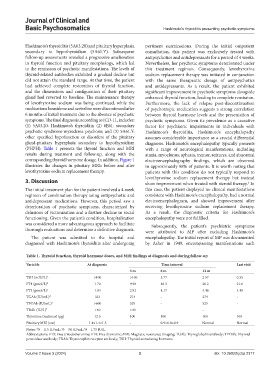
            (PHPH).  Table 1 presents the thyroid function and MRI   with a range of neurological manifestations, including
            results during treatment and follow-up, along with the   ataxia, myoclonus, aphasia, tremor, seizures, and abnormal
            corresponding thyroid hormone dosage. In addition, Figure 1   electroencephalography findings, which are observed
            illustrates the changes in pituitary MRIs before and after   in approximately 98% of patients. It is worth noting that
            levothyroxine sodium replacement therapy.          patients with this condition do not typically respond to
                                                               levothyroxine sodium replacement therapy but instead
            3. Discussion                                      show improvement when treated with steroid therapy.  In
                                                                                                          6
            The initial treatment plan for the patient involved a 4-week   this case, the patient displayed no clinical manifestations
            regimen of combination therapy using antipsychotic and   consistent with Hashimoto’s encephalopathy, had a normal
            antidepressant medications.  However, this  period saw a   electroencephalogram, and showed improvement after
            deterioration  of  psychotic  symptoms,  characterized  by   receiving levothyroxine sodium replacement therapy.
            delusions of victimization and a further decline in social   As a result, the diagnostic criteria for Hashimoto’s
            functioning. Given the patient’s condition, hospitalization   encephalopathy were not fulfilled.
            was considered a more advantageous approach to facilitate   Subsequently, the patient’s psychiatric symptoms
            thorough evaluations and determine a definitive diagnosis.  were attributed to MP after excluding Hashimoto’s
              The patient was admitted to the hospital and     encephalopathy. The initial report of MP was documented
            diagnosed  with  Hashimoto’s  thyroiditis  after  undergoing   by Asher in 1949, encompassing manifestations such

            Table 1. Thyroid function, thyroid hormone doses, and MRI findings at diagnosis and during follow-up

            Variable                  At diagnosis                    Time interval                   Last visit
                                                        3 m          6 m               12 m
            TSH (mIU/L) a                >100           >100         5.77              2.57           0.35
            FT4 (pmol/L) b               1.70           9.90         16.3              20.2           21.6
            FT3 (pmol/L) c               1.04           2.92         4.17              4.46           4.48
            TGAb (IU/mL) d               333            274          -                 279            -
            TPOAb (IU/mL) e              >600           529          -                 525            -
            TRAb (IU/L) f                >40            >40                            -
            Thyroxine treatment (μg)     12.5           100          100               100            100
            Pituitary MRI (cm)         1.4×1.4×1.5      -            0.9×0.8×0.9       Normal         Normal
            Notes:  0 – 115 IU/mL;  0 – 34 IU/mL;  0 – 1.75 IU/L.
                                     f
                           e
                 d
            Abbreviations: FT3: Free triiodothyronine; FT4: Free thyroxine; MRI: Magnetic resonance imaging; TGAb: Thyroglobulin antibody; TPOAb: Thyroid
            peroxidase antibody; TRAb: Thyrotrophin receptor antibody; TSH: Thyroid-stimulating hormone.
            Volume 2 Issue 3 (2024)                         3                               doi: 10.36922/jcbp.2317

