


Page 86 - JCBP-2-3
P. 86
Journal of Clinical and
            Basic Psychosomatics                                       Hashimoto’s thyroiditis presenting psychotic symptoms


            A                      B                           edema and approximately 26 – 37% exhibited no somatic
                                                               symptoms.  This lack of typical symptoms can potentially
                                                                        10
                                                               lead to misdiagnosis.
                                                                 The  patient’s  MRI  revealed  an  enlarged  pituitary
                                                               gland, suggesting a pituitary adenoma. Among
                                                               adenomas, prolactinomas represent the most prevalent
                                                               type, characterized by elevated prolactin (PRL) levels
                                                               (>200 ng/mL). Patients with pituitary prolactin adenomas
                                                               may present with hypothyroidism, but their TSH levels
                                                               remain unaltered despite reduced plasma FT3, FT4, T3,
                                                               and T4. In this particular instance, the patient exhibited
                                                               normal PRL levels yet displayed notably elevated TSH levels
            C                      D
                                                               in conjunction with heightened TPOAb and TRAb levels.
                                                               The  thyroid ultrasonography revealed heterogeneous
                                                               echogenicity and the presence of multiple nodules.
                                                               Consequently, these current findings strongly suggest
                                                               that the abnormal thyroid function is more indicative
                                                               of hypothyroidism caused by Hashimoto’s thyroiditis.
                                                               After the initiation of levothyroxine sodium replacement
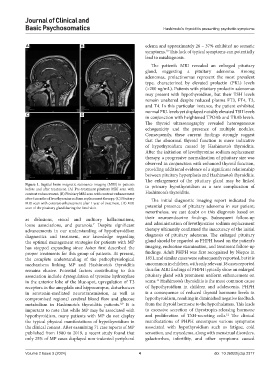
                                                               therapy, a progressive normalization of pituitary size was
                                                               observed in conjunction with enhanced thyroid function,
                                                               providing additional evidence of a significant relationship
                                                               between pituitary hyperplasia and Hashimoto’s thyroiditis.
                                                               The enlargement of the pituitary gland may be linked
            Figure 1. Sagittal brain magnetic resonance imaging (MRI) in patients   to primary hypothyroidism as a rare complication of
            before and after treatment. (A) Pre-treatment pituitary MRI scan with
            contrast enhancement. (B) Pituitary MRI scan with contrast enhancement   Hashimoto’s thyroiditis.
            after 6 months of levothyroxine sodium replacement therapy. (C) Pituitary   The initial diagnostic imaging report indicated the
            MRI scan with contrast enhancement after 1 year of treatment. (D) MRI
            scan of the pituitary gland during the final visit.  potential presence of pituitary adenoma in our patient;
                                                               nevertheless,  we  cast  doubt  on  this  diagnosis based  on
            as delusions, visual and auditory hallucinations,   their neuroendocrine findings. Subsequent follow-up
            loose associations, and paranoia.  Despite significant   and administration of levothyroxine sodium replacement
                                         7
            advancements in our understanding of hypothyroidism   therapy ultimately confirmed the inaccuracy of the initial
            diagnostics  and  treatment,  our  knowledge  regarding   diagnosis of pituitary adenoma. The enlarged pituitary
            the optimal management strategies for patients with MP   gland should be regarded as PHPH based on the patient’s
            has stopped expanding since Asher first described the   imaging, endocrine examination, and treatment follow-up
            proper treatments for this group of patients. At present,   findings. Adult PHPH was first recognized by Niepce in
            the  complete  understanding  of  the  pathophysiological   1851, and similar cases were subsequently reported, but it is
            mechanisms linking MP and Hashimoto’s thyroiditis   uncommon in children, with only relevant 18 cases reported
            remains elusive. Potential factors contributing to this   thus far. MRI findings of PHPH typically show an enlarged
            association include dysregulation of tyrosine hydroxylase   pituitary gland with prominent uniform enhancement on
                                                                    11
            in the anterior lobe of the blue-spot, upregulation of T3   scans.  Hashimoto’s thyroiditis is the most common cause
            receptors in the amygdala and hippocampus, disturbances   of hypothyroidism in children and adolescents. PHPH
            in serotonin-mediated neurotransmission, as well as   is a consequence of reduced thyroid hormone levels in
            compromised regional cerebral blood flow and glucose   hypothyroidism, resulting in diminished negative feedback
                                                    8,9
            metabolism in Hashimoto’s thyroiditis patients.  It is   from the thyroid hormone to the hypothalamus. This leads
            important to note that while MP may be associated with   to excessive secretion of thyrotropin-releasing hormone
            hypothyroidism, many patients with MP do not display   and  proliferation  of  TSH-secreting  cells.   The  clinical
                                                                                                 12
            the typical physical manifestations of hypothyroidism in   manifestations of PHPH encompass various symptoms
            the clinical context. After examining 71 case reports of MP   associated with hypothyroidism such as fatigue, cold
            published from 1980 to 2019, a recent study found that   sensation, and myxedema, along with menstrual disorders,
            only 25% of MP cases displayed non-indented peripheral   galactorrhea, infertility, and other symptoms caused


            Volume 2 Issue 3 (2024)                         4                               doi: 10.36922/jcbp.2317

