


Page 91 - JCBP-2-3
P. 91
Journal of Clinical and
            Basic Psychosomatics                                                Psychological changes in patient with ICD


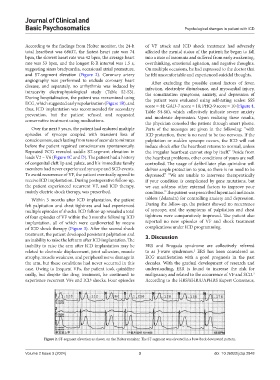
            According to the findings from Holter monitor, the 24-h   of VF attack and ICD shock treatment had adversely
            total  heartbeat  was  68637,  the  fastest  heart  rate  was  74   affected the mental status of the patient; he began to fall
            bpm, the slowest heart rate was 42 bpm, the average heart   into a state of insomnia and suffered from early awakening,
            rate was 53 bpm, and the longest R-R interval was 1.5 s,   overthinking, emotional agitation, and negative thoughts.
            suggesting sinus bradycardia, occasional atrial premature,   On multiple occasions, he had expressed to the doctor that
            and ST-segment elevation (Figure  2). Coronary artery   he felt uncomfortable and experienced suicidal thoughts.
            angiography was performed to exclude coronary heart   After excluding the possible causal factors of fever,
            disease, and separately, no arrhythmia was induced by   infection, electrolyte disturbance, and myocardial injury,
            intracavity electrophysiological study (Table S2-S3).   the somatization symptoms, anxiety, and depression of
            During hospitalization, the patient was reexamined using   the patient were evaluated using self-rating scales: SSS
            ECG, which suggested early repolarization (Figure 1B), and   score = 44; GAD-7 score = 18; PHQ-9 score = 10 (Figure 4,
            thus, ICD implantation was recommended for secondary   Table S4-S6), which collectively indicate severe anxiety
            prevention, but the patient refused and requested   and  moderate  depression.  Upon  realizing  these  results,
            conservative treatment using medications.
                                                               the physician consoled the patient through smart phone.
              Over the next 5 years, the patient had endured multiple   Parts of the messages are given in the following: “with
            episodes of syncope coupled with transient loss of   ICD protection, there is no need to be too nervous. If the
            consciousness, each lasting from tens of seconds to minutes   palpitation or sudden syncope occurs, the ICD will not
            before the patient regained consciousness spontaneously.   induce shock after the heartbeat returns to normal, unless
            Repeated ECG revealed saddle ST-segment elevation in   the irregular heartbeat cannot stop by itself.” “Aside from
            leads V2 – V6 (Figure 1C and D). The patient had a history   the heartbeat problems, other conditions of yours are well
            of congenital cleft lip and palate, and his immediate family   controlled. The usage of defibrillator plus quinidine will
            members had never experienced syncope and SCD events.   deliver ample protection to you, so there is no need to be
            To avoid recurrence of VF, the patient eventually agreed to   depressed.” “We are unable to intervene therapeutically
            receive ICD implantation. During postoperative follow-up,   if your condition is complicated by gene mutations, but
            the patient experienced recurrent VF, and ICD therapy,   we can address other external factors to improve your
            mainly electric shock therapy, was prescribed.     condition.” The patient was prescribed lupentixol melitoxin
              Within 3 months after ICD implantation, the patient   tablets (delanxin) for controlling anxiety and depression.
            felt palpitation and chest tightness and had experienced   During the follow-up, the patient showed no recurrence
            multiple episodes of shocks. ICD follow-up revealed a total   of syncope, and the symptoms of palpitation and chest
            of four episodes of VF within the 3 months following ICD   tightness were comparatively improved. The patient also
            implantation, all of which were cardioverted by means   reported no  new  episodes  of  VF  and shock treatment
            of ICD shock therapy (Figure 3). After the second shock   complications under ICD programming.
            treatment, the patient developed persistent palpitation and   3. Discussion
            an inability to raise the left arm after ICD implantation. The
            inability to raise the arm after ICD implantation may be   ERS and Brugada syndrome are collectively referred
            related to electrode displacement, joint adhesion, muscle   to as J-wave syndromes.  ERS has been considered an
                                                                                   2
            atrophy, muscle weakness, and peripheral nerve damage in   ECG manifestation with a good prognosis in the past
            the arm, but these conditions had never occurred in this   decades. With the gradual development of research and
            case. Owing to frequent VFs, the patient took quinidine   understanding, ESR is found to increase the risk for
                                                                                                             3
            orally, but despite the drug treatment, he continued to   malignancy and related to the occurrence of VF and SCD.
            experience recurrent VFs and ICD shocks. Four episodes   According to the HRS/EHRA/APHRS Expert Consensus,


                    Figure 2. ST-segment elevation as shown on the Holter monitor. The ST segment was elevated in a bow-back downward pattern.


            Volume 2 Issue 3 (2024)                         3                               doi: 10.36922/jcbp.2848

