


Page 85 - JCBP-2-4
P. 85
Journal of Clinical and
            Basic Psychosomatics                                                    Adverse life events and body image


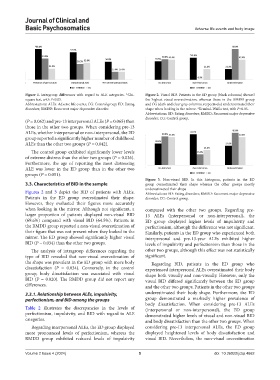
            Figure  1.  Intergroup  differences  with regard  to  ALE  categories.  *Chi-  Figure 2. Visual BID. Patients in the ED group (black columns) showed
            square test, with P<0.05.                          the highest visual overestimation, whereas those in the RMDD group
            Abbreviations: ALEs: Adverse life events; CG: Control group; ED: Eating   and CG (dark and clear gray columns, respectively) underestimated their
            disorders; RMDD: Recurrent major depressive disorder.  shape when looking in the mirror. *Kruskal–Wallis test, with P<0.05.
                                                               Abbreviations: ED: Eating disorders; RMDD: Recurrent major depressive
                                                               disorder; CG: Control group.
            (P = 0.062) and pre-13 interpersonal ALEs (P = 0.065) than
            those in the other two groups. When considering pre-13
            ALEs, whether interpersonal or non-interpersonal, the ED
            group reported a significantly higher number of childhood
            ALEs than the other two groups (P = 0.042).

              The control group exhibited significantly lower levels
            of extreme distress than the other two groups (P = 0.036).
            Furthermore, the age of reporting the most distressing
            ALE  was  lower  in  the  ED  group  than  in  the  other  two
            groups (P = 0.051).
                                                               Figure  3. Non-visual BID. In this histogram, patients in the ED
            3.3. Characteristics of BID in the sample          group overestimated their shape whereas the other groups mostly
                                                               underestimated their shape
            Figures  2  and  3  depict the BID of patients with ALEs.   Abbreviations: ED: Eating disorders; RMDD: Recurrent major depressive
            Patients in the ED group overestimated their shape.   disorder; CG: Control group.
            However, they evaluated their figures more accurately
            when looking in the mirror. Although not significant, a   compared  with  the  other  two  groups.  Regarding  pre-
            larger proportion of patients displayed non-visual BID   13  ALEs  (interpersonal  or  non-interpersonal),  the
            (69.6%) compared with visual BID (64.5%). Patients in   ED group displayed higher levels of impulsivity and
            the RMDD group reported a non-visual overestimation of   perfectionism, although the difference was not significant.
            their figure that was not present when they looked in the   Similarly, patients in the ED group who experienced both
            mirror. The ED group showed significantly higher visual   interpersonal and pre-13-year ALEs exhibited higher
            BID (P = 0.034) than the other two groups.         levels of impulsivity and perfectionism than those in the
              The analysis of intragroup differences regarding the   other two groups, although this effect was not statistically
            type of BID revealed that non-visual overestimation of   significant.
            the shape was prevalent in the ED group with more body   Regarding  BID,  patients  in  the  ED  group  who
            dissatisfaction  (P  =  0.034).  Conversely,  in  the  control   experienced interpersonal ALEs overestimated their body
            group, body dissatisfaction was associated with visual   shape both visually and non-visually. However, only the
            BID (P = 0.020). The RMDD group did not report any   visual BID differed significantly between the ED group
            differences.                                       and the other two groups. Patients in the other two groups
            3.3.1. Relationship between ALEs, impulsivity,     underestimated their body shape. Furthermore, the ED
            perfectionism, and BID among the groups            group demonstrated a markedly higher prevalence of
                                                               body dissatisfaction. When considering pre-13 ALEs
            Table  2 illustrates the discrepancies in the levels of   (interpersonal or non-interpersonal), the ED group
            perfectionism, impulsivity, and BID with regard to ALE   demonstrated higher levels of visual and non-visual BID
            categories.                                        and body dissatisfaction than the other two groups. When
              Regarding interpersonal ALEs, the ED group displayed   considering pre-13 interpersonal ALEs, the ED group
            more pronounced levels of  perfectionism,  whereas  the   displayed heightened levels of body dissatisfaction and
            RMDD group exhibited reduced levels of impulsivity   visual BID. Nevertheless, the non-visual overestimation


            Volume 2 Issue 4 (2024)                         5                               doi: 10.36922/jcbp.4662

