


Page 95 - JCBP-2-4
P. 95
Journal of Clinical and
            Basic Psychosomatics                                                 Psychopathology of COVID-19 patients


            with the first analysis, the underlying assumptions were   of life between age groups, with a P > 0.05, meaning we
            examined before proceeding with interpretation.    cannot reject the null hypothesis. However, it is worth
              None of the independent variables showed         noting that individuals aged 20 – 40 reported better quality
            multicollinearity (correlation >0.8). The results suggest   of life compared to those aged 41 – 60 (Table 4).
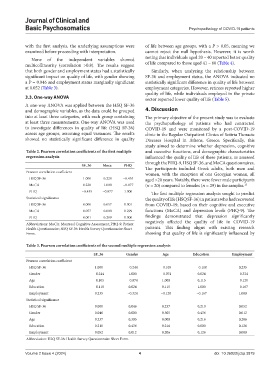
            that both gender and employment status had a statistically   Similarly, when analyzing the relationship between
            significant impact on quality of life, with gender showing   SF-36 and employment status, the ANOVA indicated no
            a P = 0.046 and employment status marginally significant   statistically significant difference in quality of life between
            at 0.052 (Table 3).                                employment categories. However, retirees reported higher
                                                               quality of life, while individuals employed in the private
            3.3. One-way ANOVA                                 sector reported lower quality of life (Table 5).
            A one-way ANOVA was applied between the HSQ SF-36
            and demographic variables, as the data could be grouped   4. Discussion
            into at least three categories, with each group containing   The primary objective of the present study was to evaluate
            at least three measurements. One-way ANOVA was used   the psychopathology of patients who had contracted
            to investigate differences in quality of life (HSQ SF-36)   COVID-19 and were monitored by a post-COVID-19
            across age groups, assuming equal variances. The results   clinic in the Regular Outpatient Clinics of Sotiria Thoracic
            showed no statistically significant difference in quality   Diseases Hospital in Athens, Greece. Specifically, this
                                                               study aimed to determine whether depression, cognitive
            Table 2. Pearson correlation coefficients of the first multiple   and executive functions, and demographic characteristics
            regression analysis                                influenced the quality of life of these patients, as assessed
                                                               through the PHQ-9, HSQ SF-36, and MoCA questionnaires.
                                    SF_36    Moca     PHQ      The participants included Greek adults, both men and
            Pearson correlation coefficient
                                                               women, with the exception of one Georgian woman, all
             HSQ SF-36              1.000    0.228   −0.435    aged >20 years. Notably, there were fewer male participants
             MoCA                   0.228    1.000   −0.077    (n = 20) compared to females (n = 29) in the samples. 15
             PHQ                    −0.435   −0.077   1.000
                                                                 The first multiple regression analysis sought to predict
            Statistical significance                           the quality of life (HSQ SF-36) in patients who had recovered
             HSQ SF-36              0.000    0.057    0.001    from COVID-19, based on their cognitive and executive
             MoCA                   0.057    0.000    0.299    functions (MoCA) and depression levels (PHQ-9). The
             PHQ                    0.001    0.299    0.000    findings demonstrated that depression significantly
            Abbreviations: MoCA: Montreal Cognitive Assessment; PHQ-9: Patient   negatively affected the quality of life in COVID-19
            Health Questionnaire; HSQ SF-36: Health Survey Questionnaire Short   patients. This finding aligns with existing research
            Form.                                              showing that quality of life is significantly influenced by

            Table 3. Pearson correlation coefficients of the second multiple regression analysis

                                         SF_36         Gender         Age          Education        Employment
            Pearson correlation coefficient
             HSQ SF-36                   1.000         −0.244        −0.105          −0.118            0.235
             Gender                      −0.244         1.000        −0.074          0.024            −0.324
             Age                         −0.105        −0.074         1.000          0.115            −0.120
             Education                   −0.118         0.024         0.115          1.000            −0.167
             Employment                  0.235         −0.324        −0.120          −0.167            1.000
            Statistical significance
             HSQ SF-36                   0.000          0.046         0.237          0.210             0.052
             Gender                      0.046          0.000         0.305          0.436             0.012
             Age                         0.237          0.305         0.000          0.216             0.206
             Education                   0.210          0.436         0.216          0.000             0.126
             Employment                  0.052          0.012         0.206          0.126             0.000
            Abbreviation: HSQ SF-36: Health Survey Questionnaire Short Form.


            Volume 2 Issue 4 (2024)                         4                               doi: 10.36922/jcbp.3879

